






Robotic Explorers Descend
An ambitious expedition was undertaken to investigate unique subterranean features known as planetary skylights, which offer a glimpse into tunnels formed
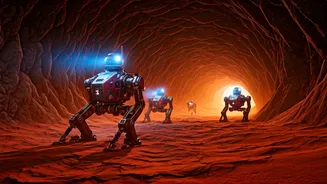
by ancient lava flows, much like those anticipated on Mars. This critical mission deployed a trio of sophisticated robots: the SherpaTT, the Coyote III, and the LUVMI-X. Each robot possessed distinct capabilities, enabling them to tackle the formidable terrain that closely resembles the Martian landscape. Their combined strengths were essential for navigating the complex and often treacherous underground environments, pushing the boundaries of what was previously thought possible for robotic exploration.
Cooperative Robotic Strategy
The success of this exploration hinged on the coordinated efforts of specialized robotic units, crucial for venturing into skylights and lava tubes. In this test scenario, the SherpaTT rover served a dual role as a stable anchor point and a mobile power source. The significantly smaller Coyote III rover was ingeniously lowered into the descent using a tether, providing a controlled and safe passage through the rocky terrain. By strategically dividing tasks, the robots achieved a remarkable synergy, enabling the sharing of vital data, electrical power, and operational stability. This collaborative approach unlocks the potential to explore hazardous underground regions that would be entirely inaccessible and unmanageable for any single robot, allowing for daring ventures into the unknown.
Scouting for Resources
The LUVMI-X robot took on the crucial role of the scout, meticulously surveying the immediate vicinity and its atmospheric conditions. Equipped with advanced instrumentation, it was tasked with identifying any indicators of water, ice, or other valuable resources that might be present within the cave system. Beyond general reconnaissance, the LUVMI-X actively examined the entrance area, capturing high-resolution imagery that proved instrumental in the team's decision-making process for selecting the optimal entry point for further exploration. This detailed scouting ensured that subsequent operations were based on solid, visual evidence.
Paving for Off-World Habitation
The outcomes of this mission definitively validate the exceptional effectiveness of autonomous robotics in exploring the most challenging planetary environments, including those on the Moon and Mars. The findings underscore the practical viability of employing a trio of advanced, next-generation rovers for comprehensive data acquisition concerning the internal and external characteristics of lava caves. By mastering independent navigation within dark, GPS-deprived settings, these robots are transforming science fiction concepts into tangible realities, effectively laying the groundwork for the establishment of the very first sustainable human settlements beyond Earth. This remarkable achievement demonstrates that intricate planetary geological formations can be accurately mapped without continuous human oversight, a significant leap forward for space exploration.