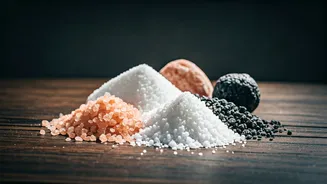

Salt's Vital Role
Salt, often taken for granted as a simple seasoning, plays an essential role in maintaining good health. It's more than just a flavor enhancer; it's a fundamental
component in numerous bodily functions. From regulating fluid balance to aiding nerve impulse transmission, salt is crucial for survival. However, the quality of salt can vary significantly, which impacts its health benefits. Choosing the right type of salt can make a difference. The market offers a wide variety of salt options, and each one possesses unique characteristics that influence its nutritional value and flavor profile. Understanding these variations is the first step toward making informed choices that can positively impact your health and culinary experiences.
Table Salt: The Basics
Table salt, the most common type found in kitchens, undergoes significant processing. This refinement removes many natural minerals and often includes additives. A critical benefit of table salt is that it’s often fortified with iodine. Iodine is a crucial nutrient for thyroid function, and iodized table salt serves as a primary source for many. While it serves a practical purpose in preventing iodine deficiency, table salt does lack the trace minerals present in less processed varieties. This processing also means that it’s frequently less flavorful than other options. Furthermore, additives may be included to prevent clumping, which could affect its overall composition and nutritional properties.
Himalayan Pink Salt
Himalayan pink salt is characterized by its pink hue and is known for containing trace minerals. These minerals, such as iron, give it its distinctive color and can contribute to its nutritional profile. Unlike table salt, it hasn't undergone extensive processing, so it retains some of its natural elements. However, it's essential to note that Himalayan pink salt is not a source of iodine. This means that if you rely solely on it, you risk not getting enough of this essential nutrient, which is essential for thyroid health. Its flavor profile is often described as slightly more complex than that of table salt. Many cooks appreciate it as a finishing salt for adding a touch of elegance and flavor to dishes. Although it has benefits, it should not fully replace iodized salt in a diet.
Kala Namak (Black Salt)
Kala namak, also known as black salt, is known for its distinct flavor and smell. It contains sulfur compounds, which contribute to its eggy aroma, and is often used in Indian cuisine to add a unique flavor. It is thought to aid digestion. Due to its strong flavor and distinctive smell, kala namak is typically used sparingly. This salt’s intense flavor makes it a versatile ingredient, often used in vegan cooking to mimic the taste of eggs. While it offers a unique culinary experience and some potential digestive benefits, it is also not a source of iodine. Similar to other specialty salts, it should be used in conjunction with iodized table salt.