






Dexterity and Detail
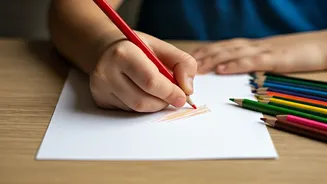
The simple act of holding a drawing tool and making deliberate marks on paper is a sophisticated exercise for a child's developing hands. This process
demands precision in controlling pressure and guiding the tool, which directly contributes to the refinement of fine motor skills. Research underscores a strong correlation between these motor abilities and broader cognitive advancements in children and adolescents. By engaging in drawing, young minds are simultaneously honing their manual dexterity and strengthening visuospatial understanding, making it a fundamental daily workout for both their hands and their burgeoning intellect. This intricate coordination is a foundational step in many learning processes.
Executive Functioning Fuel
When a child intentionally attempts to depict something through drawing, it moves beyond mere doodling into a structured cognitive process. This artistic endeavor actively engages core executive functions, including working memory, inhibitory control, and cognitive flexibility. These are the crucial mental skills that empower children to maintain focus on a task, manage impulses effectively, and transition smoothly between different thoughts or ideas. In essence, drawing encourages a child to formulate a plan, make necessary adjustments along the way, and persevere until their vision is realized. This mental discipline is vital for academic success and everyday problem-solving.
Language and Expression
Fascinating research reveals a significant and intertwined development between drawing and language acquisition during early childhood. While these may initially appear as separate developmental pathways, they are closely linked, with executive functions playing a pivotal role in mediating this relationship. Drawing provides children with a tangible means to externalize their understanding and knowledge before they possess the precise vocabulary to articulate it. This visual representation can act as a precursor to verbal expression, helping them organize thoughts and communicate concepts that might otherwise remain elusive, thereby enriching their language development.
Memory and Retrieval
The process of creating a drawing involves more than just putting pencil to paper; it’s an active engagement with memory. Children retrieve information from their minds and translate it into a visual format. Studies indicate that the act of drawing itself is contingent on memory recall, and furthermore, that the resulting drawings can serve as a valuable record of what an individual remembers over time. For young learners, this makes drawing an intuitive and gentle method for practicing their ability to recall information and structure their thoughts in a coherent manner, reinforcing their memory capacity.
Creative and Flexible Mindset
There is a clear and consistent link established by research between cognitive flexibility and creativity in children and adolescents. The greater a child's capacity to adapt their thinking, imagine new possibilities, and reframe existing ideas, the more freely their creative potential can flourish. Drawing provides a tangible space for this mental agility to manifest. It allows for imaginative freedom where a house can sprout an unusual number of windows, the sun can be depicted in unconventional colors, or a simple stick figure can blossom into a rich narrative, encouraging innovative thought processes.
Emotional Release Valve
Children often find it challenging to articulate their complex feelings and emotions through direct verbal communication. Drawings can offer a profound glimpse into a child's inner world, capturing their sentiments, perceptions, and emotional states in a non-verbal format. Research also suggests that engaging in drawing as a form of distraction can positively impact a child's mood in the short term. For many youngsters, the familiar comfort of a blank page and a drawing instrument provides a more accessible and less intimidating channel for emotional expression than a direct conversation.