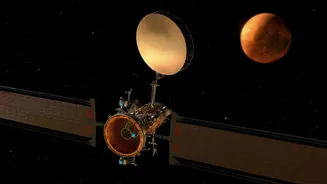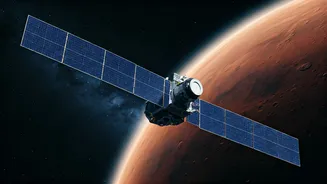








New Orbiter Initiative
NASA has officially released the final request for proposals (RFP) for a groundbreaking Mars telecommunications system. This initiative aims to establish
a dedicated communications network for future missions on and around the Red Planet. The release on May 14th sets a deadline of June 15th for interested companies to submit their proposals, with NASA anticipating a contract award by October 1st. This new orbiter, named MTN, is designed to serve as a vital data relay, augmenting the capabilities of existing orbiters that currently perform this function alongside their primary scientific objectives. The project is being funded by a significant allocation from a recent budget reconciliation act, which earmarked $700 million for the development of this Mars telecommunications orbiter, targeted for completion by the end of 2028. This investment underscores the growing importance of robust communication infrastructure for sustained exploration of Mars.
Eligibility and Competition
The legislation that funded the MTN project also stipulated specific eligibility criteria for companies vying for the contract. Bidders were intended to be limited to those who received funding in fiscal years 2024 or 2025 for Mars sample return commercial design studies. Furthermore, as part of these studies, these companies were required to have proposed a separate, independently launched Mars telecommunication orbiter that would specifically support an end-to-end Mars sample return mission. However, initial communications regarding the draft RFP created some ambiguity, with a cover letter suggesting a "full and open competition." This raised concerns on Capitol Hill that NASA might not be adhering to the legislative intent of restricting the competition to companies with prior Mars telecommunications spacecraft study experience. NASA has since clarified in the final RFP that while the competition is open, it does indeed include eligibility requirements directly tied to the budget reconciliation act, mandating demonstration of commercial Mars sample return studies and the proposal of a Mars telecom orbiter within those concepts.
Potential Bidders
A total of eight companies were involved in the commercial Mars sample return studies that could potentially qualify them for this project. These companies include prominent aerospace firms such as Blue Origin, L3Harris, Lockheed Martin, Northrop Grumman, Rocket Lab, SpaceX, Quantum Space, and Whittinghill Aerospace. NASA has not yet publicly disclosed which of these entities included a Mars telecommunications orbiter as part of their submitted study concepts. However, Blue Origin and Rocket Lab have been notably vocal proponents of a dedicated Mars telecom orbiter, openly sharing their strategies for meeting NASA's extensive requirements for both communication and scientific data relay. The final RFP incorporates updated plans, including provisions to accommodate a 20-kilogram science payload, measuring approximately 55 by 55 by 45 centimeters and requiring up to 60 watts of power, indicating a dual-purpose capability for the orbiter beyond just communication.