





Lunar Navigation Challenges
Navigating the moon presents significant hurdles, especially for long-term missions and establishing lunar bases. Current methods rely heavily on Earth-based
tracking, which can become impractical as lunar activity increases. The rugged lunar south pole, with its challenging lighting conditions, further complicates navigation for both human explorers and robotic probes. This dependence on Earth tracking limits autonomy and efficiency. Therefore, developing robust, independent positioning, navigation, and timing (PNT) systems tailored for the lunar environment is a critical goal for space agencies worldwide. Previous concepts have explored orbiting satellites and ground-based beacons, but a new, innovative approach leverages the moon's unique natural features to overcome these limitations and enable more seamless lunar exploration.
The Power of Ultrastable Lasers
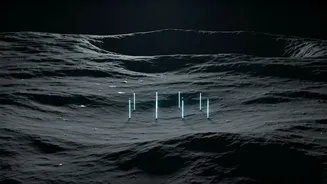
Researchers at the National Institute of Standards and Technology (NIST) have proposed an ingenious solution: deploying ultrastable lasers within the moon's permanently shadowed craters. These lasers, by emitting light with an incredibly consistent frequency, can achieve remarkable precision in measuring distances. Such stability is the key to creating a navigation system analogous to Earth's GPS. Unlike conventional lasers that can be easily destabilized by minor temperature fluctuations or vibrations, these specialized systems are designed for extreme precision. The ability to measure distances with such accuracy is fundamental for any positioning system, allowing for the triangulation needed to pinpoint locations on the lunar surface and track the movement of spacecraft with unprecedented reliability.
Craters: Ideal Lunar Labs
The moon's permanently shadowed craters, found predominantly near the poles, offer a unique and almost perfect environment for housing these sensitive laser systems. These regions never receive direct sunlight due to the moon's minimal axial tilt, resulting in temperatures that plummet to approximately minus 370 degrees Fahrenheit (minus 223 degrees Celsius). These extreme cold temperatures, far colder than Earth's coldest environments, are crucial. On Earth, achieving such laser stability requires complex cryogenic cooling and extensive vibration isolation. However, within these lunar craters, the natural frigid conditions could significantly reduce or even eliminate the need for artificial climate control. This natural advantage makes these craters ideal, low-maintenance laboratories for precision optical experiments, drastically simplifying the engineering challenges associated with deploying such technology.
A Naturally Stable System
The proposed system would utilize a silicon optical cavity, a device that stabilizes laser light by precisely reflecting it between mirrors. On Earth, maintaining the required stability for such cavities is an elaborate process, demanding sophisticated cooling systems and isolation from even the slightest tremors. Fortunately, the lunar craters provide a ready-made solution. The combination of extreme cold, the moon's inherent vacuum, and minimal seismic activity creates an environment where thermal expansion in the optical cavity would be virtually nonexistent. This natural stability allows the laser's frequency to remain exceptionally constant, a critical factor for accurate distance measurements. This precise frequency is what enables the laser system to function as a highly reliable beacon for navigation, supporting future lunar satellites and communication networks.
Building Lunar GPS
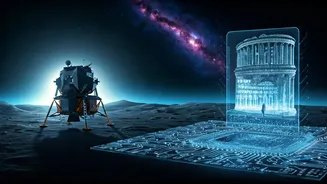
The vision is to transform these frigid craters into the backbone of an optical atomic clock network on the moon, akin to the atomic clocks that power Earth's GPS. Once an optical cavity is installed and stabilized within a shadowed crater, it would lock a nearby laser to a single, highly accurate frequency. This stabilized signal could then act as a fundamental timing reference for a new lunar navigation system. By linking with orbiting satellites or other ground-based components, this laser beacon would provide precise positional data. This advanced system promises to offer lunar astronauts, rovers, and future spacecraft a reliable, on-demand navigation capability, reducing their reliance on Earth and paving the way for more ambitious and autonomous lunar exploration and settlement.