







What Are Swarm Drones?
Moving beyond traditional remotely piloted aircraft, swarm drones represent a significant evolution in unmanned aerial systems. Unlike single drones operated
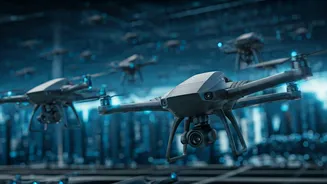
by an individual, swarm drones are a collection of multiple unmanned vehicles that operate in a coordinated fashion, often guided by advanced artificial intelligence or complex algorithms. This collective intelligence allows them to perform intricate tasks collaboratively, a stark contrast to the 'fire-and-forget' capability of some older attack drones that rely solely on pre-programmed GPS navigation. The true power of a drone swarm lies in its synchronized actions and emergent behavior, enabling them to tackle objectives far beyond the capacity of individual units. This networked approach to aerial operations signifies a paradigm shift in how autonomous systems can be deployed for various critical missions, from military engagements to large-scale surveillance and logistical support.
Global Swarm Development
The global landscape of drone swarm technology is dynamic, with several leading nations actively investing in its research and development. Countries such as the United States, China, Russia, and Ukraine are at the forefront of this technological race, pushing the boundaries of what these coordinated aerial systems can achieve. This intense competition underscores the strategic importance of swarm technology in contemporary defense strategies. The geopolitical implications are significant, as demonstrated by past events such as Pakistan's use of Turkish-provided swarm drones during Operation Sindoor against India. Such incidents highlight the immediate need for nations to bolster their own capabilities in this domain. Recognizing this, India is accelerating its efforts to develop its own advanced attack drones and integrated swarm systems, aiming to maintain strategic parity and enhance national security in an increasingly complex global security environment.
India's Swarm Initiative
India is making substantial strides in developing indigenous swarm drone capabilities to bolster its defense infrastructure and prepare for future conflicts and rescue operations. Reports indicate that the Defence Research and Development Organisation (DRDO) is spearheading the creation of a stealth jet-powered swarm loitering munition system. This advanced system is anticipated to possess an impressive strike range of 300 to 600 kilometers, enabling deep-strike missions with remarkable precision. A key feature of these upcoming drones will be their stealth capabilities, designed to evade radar detection and penetrate sophisticated air-defense networks, making them formidable assets in contested airspace. This development signifies India's commitment to leveraging cutting-edge technology for national security and its growing prowess in advanced aerial warfare systems, ensuring a robust defense against potential threats.
Strategic Swarm Roles
The strategic applications of swarm drones extend far beyond simple offensive capabilities, encompassing crucial roles in deception and intelligence gathering. These coordinated aerial units can execute multiple strikes simultaneously, overwhelming enemy defenses. Furthermore, they serve as effective decoys, surrounding a primary target or missile to confuse and divert air defense systems, thereby creating openings for follow-on attacks. Beyond their offensive utility, swarm drones are invaluable for reconnaissance missions. They can be deployed to precisely map the locations of enemy air defense installations, providing critical intelligence that informs tactical decisions and helps military planners identify optimal attack vectors. This multifaceted utility makes swarm technology an indispensable component of modern military strategy, enhancing both offensive power and defensive awareness on the battlefield.
Kamikaze & UCAV Projects
Complementing its development of swarm drone systems, India is also actively pursuing advancements in kamikaze drone technology and Unmanned Combat Aerial Vehicles (UCAVs). Undergoing trials are indigenous kamikaze drones named KAL and Sheshnaag, inspired by Iran's Shahed drones. These powerful systems boast a significant operational range of approximately 1,000 kilometers and can carry a substantial payload of around 40 kilograms of explosives, indicating a promising leap forward for the Indian Armed Forces in terms of precision strike capabilities. In parallel, India is developing the Ghatak UCAV, a pilotless combat aircraft designed to operate similarly to a manned fighter jet like the Tejas, but without the need for a pilot. This aircraft will be powered by advanced Kaveri derivative engines, further enhancing India's indigenous defense manufacturing capabilities and its strategic autonomy in advanced aerial warfare.