







Ancient Origins of Apples
The story of apples begins with a single, ancient tree, the progenitor of all its kind, or so it seems. This particular tree stands as a testament to time,
having existed for centuries. The narrative prompts us to question whether this lineage is truly singular. In reflecting on the morning, a common day of rest, the author is jolted awake by her dog, Oreo, highlighting the everyday reality that often interrupts our idealised notions of time. This routine leads to the preparation of breakfast, a moment where the adult burden of choice, particularly between indulgent desires and healthy options, comes into play. The sight of an apple prompts the well-known adage, 'an apple a day keeps the doctor away.' This familiar saying, when considered by a medical professional, sparks a playful contemplation of self-prevention and the metaphysical implications of such a proverb. The author muses on whether this internal dialogue is a mere excuse to avoid eating the fruit, delving into the complex relationship between simple objects and the vast repositories of knowledge they can unlock within the mind.
Global Varieties and Myths
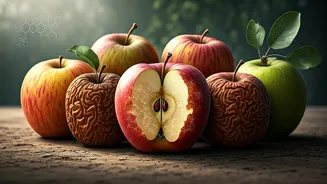
Apples are incredibly diverse, showcasing a spectrum of sizes, colors, and flavors that span the globe. Within India alone, regions like Himachal Pradesh boast distinct varieties such as the petite Kashmiri apples, the deep, almost purple Kinnaur apples, the vibrant royal apples, and the pale golden apples. This regional richness is just a glimpse of the global tapestry of apples. Internationally recognized types include the tart Granny Smith, the exceptionally sweet Honeycrisp, and the Pink Lady, which conjures images of elegant, candied treats. Beyond their culinary appeal, apples are deeply embedded in our collective consciousness. They feature prominently in mythology and folklore, from the fabled poisoned apple in Snow White to the biblical apple from the Tree of Knowledge in Eden. Historically, the image of an apple falling on Isaac Newton's head is credited with inspiring his groundbreaking discovery of gravity. For many, including the author, apples evoke powerful sensory memories, like the scent of orchards experienced during childhood journeys through Himachal Pradesh, underscoring their rich cultural and symbolic significance.
The Science of Clones
Stepping into the realm of imagination allows for extraordinary insights, such as encountering talking trees. In this whimsical scenario, when asked their names, multiple apple trees respond with the same name, 'Komal.' This peculiar repetition leads to a profound realization: these are not individual trees, but clones. This concept extends beyond the fictional setting to explain the reality of apple cultivation. When we speak of a specific apple variety, like those from Himachal Pradesh, all the trees bearing that fruit are typically genetic copies of a single ancestral tree. This practice of cloning has been employed for centuries, ensuring that each subsequent tree produces fruit identical to its predecessor. This method raises questions about why cloning is so prevalent in apple cultivation and whether growing apples from seeds is a viable alternative. The entire process highlights how humans have managed to domesticate apples, a feat that might have seemed unlikely given their biological nature, and how this domestication has continued to shape our history and relationship with this fruit.
Anya's Extraordinary Path
The narrative shifts to Anya, a young woman standing at a pivotal moment in her life, grappling with inherited expectations and a predetermined destiny. Her grandmother spoke of an 'extraordinary' path, a concept Anya once dismissed as fantasy. Now, facing her own crossroads, this idea resonates with a compelling urgency. The sprawling city, a symbol of both opportunity and anonymity, mirrors Anya's internal conflict. She feels like a small part of a vast, impersonal system, yet senses an untapped potential within herself. Recalling stories of women who defied convention and carved their own paths, Anya finds inspiration. These were not figures of public spectacle, but individuals who discovered their strength in everyday acts of courage. Taking a deep breath amidst the city's contrasting scents, Anya acknowledges her roots while yearning for a self-defined future. Though the path ahead is uncertain and challenging, she feels a newfound sense of control, a quiet resolve to author her own story and embrace the extraordinary within. The weight of her legacy transforms from a burden into a foundation, marking the beginning of her journey to unravel generational cycles, thread by thread, with a courage she never knew she possessed.