




Understanding the Blood Moon
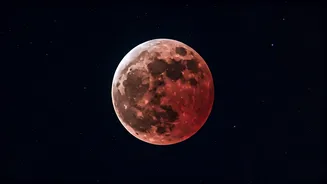
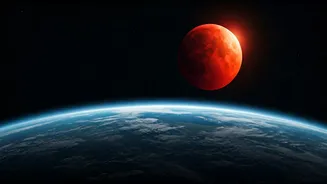
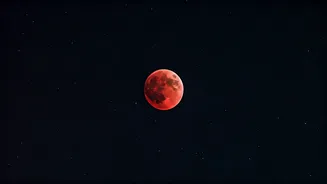
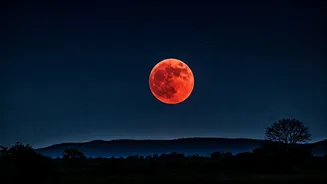
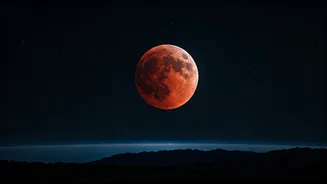
The 'Blood Moon' phenomenon, a captivating total lunar eclipse, occurs when our planet, Earth, positions itself directly between the Sun and the Moon.
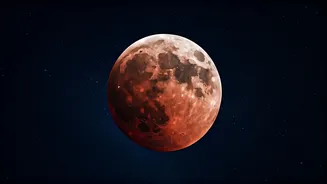
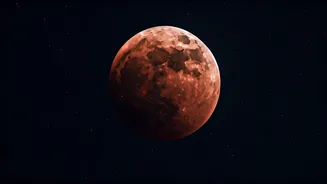
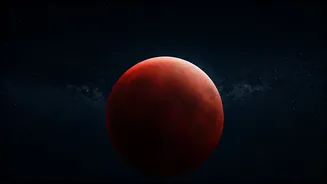
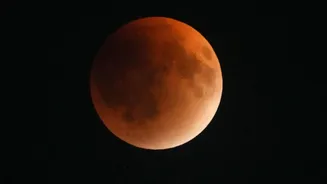
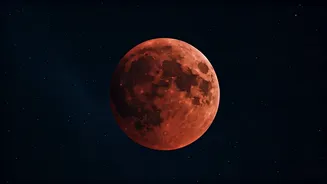
This alignment causes Earth to cast its shadow upon the lunar surface. As sunlight traverses Earth's atmosphere, it gets refracted and filtered, with the red wavelengths being more prominently scattered towards the Moon. This scattering effect imbues the Moon with a distinctive deep red or coppery hue, earning it the evocative 'Blood Moon' moniker. Unlike its solar counterpart, observing a lunar eclipse requires no specialized protective gear; the naked eye is perfectly sufficient for a safe and awe-inspiring viewing experience. This particular eclipse on March 3, 2026, is noteworthy as it will be visible from India, a privilege not granted by every lunar eclipse event globally, making it a special occasion for sky gazers across the nation.
Eclipse Timing in India
For skywatchers in India, the celestial event of the total lunar eclipse on March 3, 2026, will unfold in the late afternoon and evening. The initial, fainter penumbral phase of the eclipse will commence at approximately 4:58 PM Indian Standard Time (IST). Following this, the most dramatic part of the eclipse, the totality phase, where the Moon will appear truly red, is slated to occur from 4:58 PM until 5:32 PM IST. The peak of this spectacular event, the maximum eclipse, will be observable between roughly 5:10 PM and 5:25 PM IST, though the exact timing might vary slightly depending on your specific city's location. The eclipse will conclude its penumbral phase by 7:53 PM IST. A crucial aspect for Indian viewers is that in many parts of the country, the Moon will be rising during the eclipse. This means that observers in numerous regions will likely catch only the latter stages of the event, typically around 20 minutes leading up to and during moonrise, so a late night is not anticipated.
Northeast India's Prime View
For those seeking the most encompassing and dramatic viewing experience of the March 3rd lunar eclipse, Northeast India emerges as the premier destination. Several cities in this region are anticipated to witness the full totality of the event, meaning the Moon will be entirely enveloped by Earth's shadow at some point. Prominent viewing locations include Dibrugarh, Dispur, Guwahati, Itanagar, and Shillong. In these areas, the eclipse will begin in the afternoon and extend into the evening, with the peak of totality occurring conveniently around sunset. It's quite possible that residents may witness the Moon ascending above the horizon already displaying its characteristic deep red glow, an exceptionally rare and memorable sight. For the best visual experience, it is advisable to seek elevated vantage points, tranquil riverbanks, or open, expansive hill landscapes that offer an unobstructed view of the horizon and minimize light pollution.
Eastern India's Partial Spectacle
In the eastern parts of India, including prominent cities like Kolkata, Bhubaneswar, and Patna, the lunar eclipse on March 3, 2026, will present a beautiful, albeit partial, view. These locations are expected to experience the latter stages of totality or the beginning of the partial phase as the Moon ascends. While the deepest crimson phase might be concluding by the time the Moon is visible, observers will still be treated to the captivating visual of the lunar disc gradually brightening as it emerges from Earth's shadow. This transition offers a wonderful opportunity for photographers to capture the evolving celestial display. Ideal viewing spots in these cities would include riverside promenades that offer a clear eastern view, elevated terraces of buildings, or spacious, open parks that provide an unobstructed perspective of the moonrise.
North & Central Views
For skywatchers located in North and Central India, cities such as Delhi, Jaipur, Lucknow, and Bhopal will primarily witness the concluding partial phase of the lunar eclipse on March 3, 2026. Although the phase of complete totality will have passed by the time the Moon becomes visible in these areas, the visual transition occurring at moonrise can still offer a remarkably memorable skywatching moment. The experience will be enhanced by seeking out locations with open landscapes or the reflective beauty of lakefronts, which can provide a broader and clearer view of the eastern horizon. Even this partial glimpse of the Moon emerging from Earth's shadow offers a unique perspective on astronomical mechanics and a chance to connect with the cosmos.
Western & Southern Glimpses
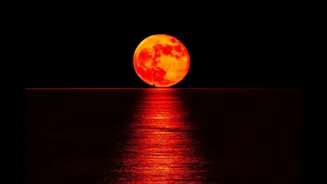
Residents in Western and Southern India, including major metropolises like Mumbai, Ahmedabad, Chennai, Bengaluru, and Hyderabad, will also experience only the final stages of the lunar eclipse on March 3, 2026. The timing of moonrise in these regions means that the most dramatic phases of the eclipse will have already occurred. Nevertheless, the end of the eclipse still presents a visually appealing scene, particularly when combined with the unique geographical features of these areas. Coastal and waterfront locations are particularly recommended as stunning viewing points. Imagine the spectacle of the Moon, faintly tinged with red, slowly ascending over the sea or a large body of water, creating a serene and unforgettable image. These picturesque settings will enhance the viewing experience, even if it's just a brief glimpse of the final moments of the eclipse.
Effortless Eclipse Viewing
Witnessing the captivating spectacle of the Blood Moon lunar eclipse on March 3, 2026, requires minimal preparation, making it an accessible event for everyone. Unlike solar eclipses, no special protective eyewear is necessary to observe a lunar eclipse; it is entirely safe to view with the naked eye. The key is to find a location with a clear, unobstructed view of the eastern horizon. If possible, try to move away from the glare of bright city lights, as this will significantly improve the visibility of the subtle colours of the Moon. While not essential, using binoculars can offer a more detailed and enhanced view of the lunar surface and the nuances of the eclipse. Ideal viewing spots include elevated positions like rooftops, open beaches, expansive hilltops, or large, open fields, all of which provide an excellent panorama of the night sky.