






A New Space Era
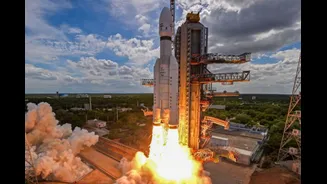
India is on the cusp of a significant milestone in its space exploration journey with the impending launch of Vikram-1, set to be the nation's inaugural
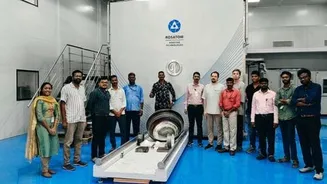
privately developed orbital rocket. Skyroot Aerospace recently conducted a crucial flag-off ceremony in Hyderabad for the payload fairing, the vital component that safeguards satellites during ascent. This payload fairing is now en route to Sriharikota, India's sole spaceport, for meticulous integration with the remainder of the launch vehicle. The company's co-founder and COO, Naga Bharath Daka, expressed enthusiasm about commencing integration and launch campaign activities, signifying critical steps towards this historic endeavor. The launch campaign encompasses the period leading up to liftoff, during which the rocket undergoes final assembly, rigorous testing, and comprehensive preparation for its mission. This development represents a pivotal moment, not just for Skyroot, but for the entire Indian private space technology industry, signaling its growing capabilities and ambition.
Vikram-1's Ingenuity
The Vikram-1 launch vehicle stands out due to its innovative design and materials. Unlike traditional rockets often built with metals, Vikram-1 extensively utilizes carbon composites, a choice that enhances its structural integrity while reducing overall weight. This advanced material contributes to a more efficient and potentially cost-effective manufacturing process. At its core, the rocket boasts an indigenously developed, 3D-printed engine, a testament to India's growing prowess in additive manufacturing for aerospace applications. This proprietary engine technology promises quicker assembly and assembly times, further streamlining the development cycle. Designed for multi-stage flight, Vikram-1 incorporates both solid and liquid fuel-based propulsion systems, engineered to ferry satellites weighing up to 350 kilograms into low Earth orbit (LEO). LEO, generally defined as the region between 160 and 2,000 kilometers above Earth's surface, is a increasingly popular destination for satellite constellations, such as those used for global communication networks.
Honoring Visionaries
The naming of Skyroot Aerospace's orbital rocket and its propulsion systems pays homage to luminaries who have profoundly shaped India's scientific and space endeavors. The primary launch vehicle itself, Vikram-1, is named in honor of Dr. Vikram Sarabhai, widely recognized as the father of the Indian space program. His foundational vision and leadership laid the groundwork for India's space agency, ISRO, and its subsequent achievements. Further honoring scientific giants, the rocket's propulsion systems bear names derived from other eminent figures. The solid propulsion system is christened 'Kalam', in tribute to Dr. A.P.J. Abdul Kalam, a renowned aerospace scientist and former President of India. The liquid propulsion system is named 'Raman', acknowledging the groundbreaking work of Sir C.V. Raman, a Nobel laureate in Physics. Lastly, the cryogenic propulsion system is dedicated to 'Dhawan', recognizing the contributions of Dr. Satish Dhawan, a distinguished scientist and former chairman of ISRO, who played a crucial role in advancing India's rocket technology.
Market Impact
With the successful flight hardware flag-off for Vikram-1, Skyroot Aerospace is strategically positioning itself to cater to the rapidly expanding global market for satellite launches. Pawan Kumar Chandana, co-founder and CEO of Skyroot, articulated the company's ambition to democratize access to space, enabling on-demand satellite deployment for a diverse clientele. The launch of Vikram-1 is anticipated to mark a significant turning point for India's nascent private space-tech industry, showcasing its capacity to compete on an international level. This advancement aligns with the Telangana government's vision, as highlighted by Chief Minister A. Revanth Reddy, to establish the state as a leader in the aerospace sector. Telangana's proactive approach, including the development of its own space policy, aims to foster specialized space manufacturing hubs. This initiative mirrors efforts seen in other Indian states, such as Tamil Nadu's focus on launch vehicles and Gujarat's specialization in satellite technology, collectively strengthening India's overall space ecosystem and its potential for commercial space ventures.