



Forgotten Archives Rediscovered
A remarkable exhibition in Delhi is bringing to light a collection of 77 historical images, meticulously captured almost 170 years ago by the intrepid
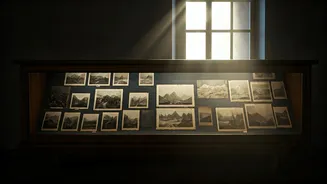
German explorers, the Schlagintweit brothers. These aren't just mere pictures; they are a testament to colonial-era scientific surveys of what was then termed 'high Asia.' This collection, comprising early photographs and intricate paintings, offers the Indian public an unprecedented view of Himalayan landscapes, ancient temples, and remote territories that have likely undergone significant changes over the past century and a half. For a long time, these visual records remained largely confined to European archives, known primarily to a select group of mountaineering historians and scholars. This exhibition marks a pivotal moment, making these treasures accessible to a broader audience and allowing a fascinating comparison between past and present Himalayan vistas.
The Schlagintweit Expedition's Mission
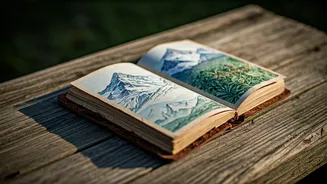
In 1854, driven by a scientific endeavor, the East India Company commissioned the three Schlagintweit geologist siblings—Adolph, Hermann, and Robert—to extend the magnetic survey across the Indian subcontinent. While the Great Trigonometrical Survey was already mapping vast swathes, the northern Himalayan regions remained largely uncharted. Navigating a complex geopolitical terrain, with permissions granted by some regions like Kashmir but denied by others, the brothers embarked on their ambitious mission. They pioneered the use of the camera in their surveys within India, supplementing their photographic endeavors with detailed paintings, often based on their low-resolution prints. Their groundbreaking work, later compiled into seven volumes, combined maps, precise measurements, and these invaluable visual records, painting a comprehensive picture of the 'high Asia' they explored.
A Treasure Trove Unveiled
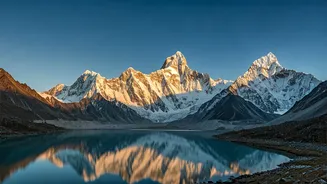
The exhibition in Delhi proudly displays 77 of the Schlagintweits' documented observations, with a significant portion being shown to the public for the very first time. Among these new reveals is a breathtaking panoramic vista of Srinagar's Dal Lake, serenely framed by snow-capped peaks, and an intriguing view of the Bogapani Bridge in present-day Meghalaya, a structure ingeniously supported by wooden stilts across a steep incline. The broader collection vividly portrays the region's rivers, sacred temples, quaint settlements, and rugged high-altitude terrains from an era when the colonial administration's objective was global cartography, including the most inaccessible parts of the Himalayas. These are not original works but high-quality reproductions of the Schlagintweits' original paintings and early photographic prints, drawn from an extensive archive of approximately 700 sketches of India and its surrounding 'high Asia.'
Bringing History Back Home
The ambitious project to repatriate these historic images to India began to take shape in 2015. Co-curator Hermann Kreutzmann conceived the idea after encountering a compelling exhibition of the Schlagintweits' paintings, featuring sites like Nainital, Badrinath, Kedarnath, Kanchenjunga, Ladakh, and various Tibetan monasteries, at the Alpines Museum in Munich. Expressing his sheer delight at discovering this 'khazana' of artistic documentation, he immediately envisioned a similar display within India. The Schlagintweits' surveys and the data they collected formed a crucial foundation for subsequent meteorological and geological investigations in the Himalayas. Their legacy extends beyond visuals; their collected samples of rocks, minerals, plants, and ethnographic artifacts are now housed in esteemed museums across Germany, England, and Pakistan, representing a multi-faceted contribution to understanding the region.
Exhibition Tour Details
Following its debut in Delhi, this significant exhibition, titled 'Himalayan Encounters: Hidden Views from 170 Years Ago,' is embarking on a journey across other key locations. Audiences in Dehradun can experience these historical perspectives at the Doon Library and Research Centre from May 1st to May 9th. Subsequently, the exhibition will travel to Nainital, where it will be accessible at the CRST Inter College from May 12th to May 18th. This travelling showcase aims to provide audiences with a direct and intimate connection to their region's past. By presenting these visual archives, the exhibition not only revives the compelling narrative of the Schlagintweit brothers' exploration but also serves as a poignant reminder that the Himalayas are a continuously evolving landscape, as well as a living repository of history.