







Pegasus's Humble Beginnings
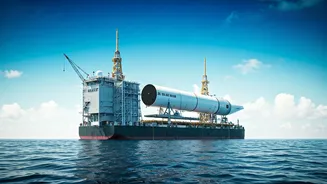
NASA's colossal barge, Pegasus, wasn't always destined to carry the massive Space Launch System (SLS) core stage. Its initial purpose, commissioned in 1999,
was to support the now-defunct Space Shuttle Program. Specifically, it was tasked with the critical job of moving the colossal external fuel tanks from their manufacturing site in Louisiana all the way to Florida. These tanks, iconic components of the space shuttle, were a significant feat of engineering in themselves. However, the requirements for transporting the SLS core stage presented a far greater challenge. The SLS core stage, essentially the backbone of the new rocket, dwarfs the former shuttle fuel tanks in both size and weight, proving that Pegasus's capabilities would need a substantial upgrade to meet NASA's future ambitions.
Adapting for SLS Might
The sheer scale of the SLS core stage necessitated a significant transformation of the Pegasus barge. Engineers and specialized crews in Louisiana undertook the challenging task of modifying Pegasus to accommodate this new, larger payload. This involved a complex engineering process where a 115-foot section of the original barge was meticulously removed. In its place, a substantially longer 165-foot section was integrated. This extensive alteration expanded the barge's overall length from its initial 260 feet to an impressive 310 feet. Crucially, this lengthening also dramatically increased its cargo-carrying capacity, making it suitable for the immense weight and dimensions of the SLS core stage, a feat that underscores NASA's commitment to adapting its infrastructure for groundbreaking space exploration endeavors.
A Legacy of Water Transport
The utilization of barges for transporting massive rocket components is a long-standing practice within NASA's history. Pegasus is not an anomaly but rather the latest in a line of colossal watercraft. It effectively superseded two earlier barges, Poseidon and Orion, which were instrumental in ferrying the stages of the Saturn rocket system. This iconic rocket system powered the Apollo program, famously taking humans to the moon. The continued reliance on barge transportation, now exemplified by Pegasus, highlights the enduring efficiency and necessity of this method for moving extraordinarily large and heavy payloads across significant distances. As NASA gears up for future Artemis missions, the role of these specialized vessels in facilitating lunar exploration remains paramount.
Pegasus: A Unique Vessel
Visually, the Pegasus barge presents a rather unusual appearance, often described as a hybrid between a massive hangar and a watercraft. This analogy holds some truth, as Pegasus is not self-propelled; it lacks the powerful onboard engines one might expect. Instead, its movement, whether carrying a load or empty, is orchestrated by dedicated towing vessels and tugboats. Despite its impressive 310-foot length from bow to stern, the functional cargo deck space is approximately 240 feet, indicating that the SLS core stage occupies a significant portion of this usable area, making for a very precise fit. This unique design emphasizes its specialized function as a floating platform for colossal payloads, requiring external power to navigate.
Supporting Artemis Missions
Pegasus has already proven its indispensable role in NASA's ambitious Artemis program. On July 16, 2024, it embarked on a substantial 900-mile journey, carrying the critical core stage for the Artemis II mission, which successfully sent astronauts on a lunar flyby. Furthermore, Pegasus continues to be a linchpin for subsequent missions. On April 28, 2026, it delivered the core stage destined for Artemis III, a mission focused on testing the SLS's capability to rendezvous with other spacecraft in orbit. This preparation is vital for NASA's overarching goal of establishing a sustained lunar presence, with a planned moon landing as part of Artemis IV anticipated around 2028, showcasing Pegasus's ongoing and vital contribution to humanity's return to the Moon.