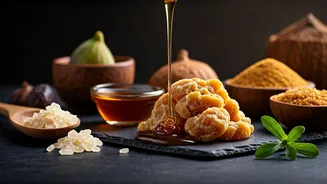

Jaggery: The Golden Staple
Jaggery, or 'gur', stands as a beloved, time-honored sweetener in Indian households, celebrated for its minimal processing which preserves valuable molasses.
Unlike stark white sugar, which undergoes extensive refining, jaggery retains trace amounts of iron, calcium, magnesium, and potassium, offering a slight nutritional edge. Its flavor profile is distinctly richer and more complex than granulated sugar, boasting notes of caramel with a subtle earthiness that beautifully complements traditional Indian preparations. Imagine the enhanced depth it lends to kheer, the robust character it imparts to gajar halwa, or the delightful transformation of til ke laddoo. For a straightforward substitution, jaggery can be used in a 1:1 ratio with white sugar, though be mindful of the warm amber hue it introduces to your dishes, such as a beautifully colored kheer. It is exceptionally well-suited for traditional Indian sweets, halwa, laddoo, payasam, chikki, and comforting winter desserts, adding both sweetness and character.
Raw Honey: Nature's Elixir
Raw honey represents a pinnacle of minimally processed sweeteners, far removed from the highly refined versions often found in supermarkets. It is carefully harvested and lightly filtered, ensuring the preservation of its inherent antioxidants, enzymes, pollen, and potent antimicrobial properties – qualities that have cemented its revered status in Ayurvedic practices for millennia. The glycemic index of honey varies by type, generally falling between 45 and 69, which is notably lower than both jaggery and standard table sugar. While it contains approximately 240 to 330 calories per 100 grams, honey's superior sweetness means you can use less to achieve the desired level of taste. A crucial consideration for any culinary application, particularly baking, is to avoid heating honey beyond 40°C, as high temperatures can degrade its beneficial compounds and potentially create undesirable byproducts. For warm dishes, it's best to incorporate honey after cooking, perhaps as a decadent drizzle over warm gulab jamun, stirred into milk just before it boils, or as a delightful sweetener for chilled desserts, fruit salads, and shrikhand. It truly shines in cold desserts, fruit-based preparations, chilled kheer, shrikhand, yogurt parfaits, energy laddoo, and as a final flourish of sweetness.
Dates: Sweet Powerhouses
Dates, or 'khajur', are an often-underestimated natural sweetener, offering a complete package of natural sugars combined with dietary fiber, iron, potassium, and magnesium. As a whole food, they provide a slower release of sugars into the bloodstream due to their significant fiber content, resulting in a glycemic index of only 40 to 55, a marked improvement over refined sugar. Their versatility in the kitchen is remarkable; simply soaking pitted dates in warm water for about 15-20 minutes and then blending them creates a smooth paste. This date paste is an exceptional binder and sweetener for no-bake desserts, ladoos, or energy balls, effectively combining dry ingredients. It can even serve as a direct 1:1 replacement for sugar in classic Indian sweets like besan laddoo and burfi, lending a delightful caramel-like depth. Dates are ideal for making ladoos, energy balls, no-bake burfi, dry fruit barfi, halwa, kheer, and any dessert where a rich, caramel undertone is desired.
Coconut Sugar: Tropical Caramel
Derived from the sap of coconut palm blossoms, coconut sugar presents a delightful warm, caramel-like flavor, closely mirroring that of brown or raw cane sugar. Visually similar to coarse brown sugar and dissolving just as readily, it functions almost identically to regular sugar in baking, making it a highly convenient choice for frequent bakers. Its glycemic index hovers around 54, positioning it as a lower-glycemic alternative compared to white sugar (GI approx. 65) and most forms of jaggery. Coconut sugar also contributes trace amounts of minerals like zinc, iron, calcium, and potassium. While readily accessible in health food stores and online, it is typically priced higher than many traditional Indian sweeteners. In most recipes, it can be employed in a 1:1 substitution for white sugar, seamlessly integrating into kheer, halwa, cake batters, cookie dough, and puddings without requiring adjustments to quantities or technique. It is particularly well-suited for baking, kheer, halwa, chocolate-infused Indian fusion creations, and any application calling for the flavor profile of brown sugar.
Maple Syrup: A North American Gem
While not a traditional Indian ingredient, maple syrup has carved out a significant niche in contemporary Indian kitchens due to its genuine nutritional merits. Pure maple syrup, distinct from sugary pancake syrups laden with high-fructose corn syrup, is sourced from the sap of maple trees and is a valuable source of manganese, zinc, and antioxidants. It shares a glycemic index of approximately 54 with coconut sugar. Its flavor is unique and captivating, offering a sweetness balanced by woody and subtly smoky undertones. Its intense flavor means a smaller amount delivers significant sweetness. When substituting sugar with maple syrup, aim for about 75% of the quantity and slightly reduce other liquids in the recipe to account for the added moisture. For the most robust flavor and highest antioxidant content, opt for Grade A dark amber or Grade B varieties, which are widely available online and in premium grocery stores across India. Maple syrup is an excellent choice for baking, halwa, payasam, yogurt-based desserts, and as a final sweetening touch for chilled dishes.
Stevia: The Zero-Calorie Leaf
Stevia, extracted from the leaves of the Stevia rebaudiana plant, a shrub native to South America, has seen a dramatic surge in popularity in India, particularly with the growing awareness around blood sugar management. Its most compelling attribute is its zero glycemic index and zero calorie count, meaning it does not elevate blood sugar levels or provoke an insulin response, making it an exceptional choice for individuals managing diabetes, pre-diabetes, or weight. In practical terms, a minuscule amount of stevia – a pinch of powder or a few drops of liquid – is equivalent to a teaspoon of sugar. However, pure stevia can sometimes impart a slightly bitter aftertaste, especially in larger quantities. The key to successfully using stevia is to pair it with other strong flavors like vanilla, cardamom, or saffron, which effectively mask any subtle bitterness. It is ideal for diabetic-friendly desserts, kheer, smoothies, chai, yogurt-based sweets, and any recipe where a complete absence of caloric or glycemic impact is desired.
Monk Fruit Sweetener: Exotic Sweetness
Monk fruit sweetener is derived from an extract of the monk fruit (Siraitia grosvenorii), a small green fruit indigenous to southern China. The sweet compounds within, known as mogrosides, are astonishingly 250 to 300 times sweeter than sugar, allowing for the use of very small quantities to achieve intense sweetness. It boasts zero calories and a virtually zero glycemic index, positioning it as a direct competitor to stevia for those focused on diabetes management or weight control. Unlike stevia, monk fruit sweetener offers a distinct flavor profile with subtle fruity, caramelized notes and minimal bitterness, making it a more palatable option for many in both hot and cold culinary applications. It is also notably heat-stable, performing admirably in baked goods, hot beverages, and cooked Indian desserts. The primary hurdle for Indian consumers lies in its availability and cost; monk fruit sweetener is less common and significantly more expensive than stevia in India, typically ranging from Rs 500 to Rs 1,000 for 100 grams. It is generally found online, often blended with erythritol. For those sensitive to stevia's aftertaste, monk fruit sweetener is a premium option worth considering. It excels in baking, hot and cold beverages, diabetic-friendly halwa and kheer, and serves as an excellent alternative for those who find stevia's taste profile less appealing.
Fruit Purees: Nature's Binders
Fruit purees, including mashed bananas and other fruit concoctions, represent a remarkably useful and often overlooked natural sweetener category for both home baking and no-cook Indian desserts. Overripe bananas, in particular, are naturally very sweet, offering a good source of potassium and vitamin B6, along with pectin, a beneficial dietary fiber that aids digestion. Mashed ripe banana can effectively substitute up to half the sugar required in recipes like banana halwa, banana sheera, or various baked goods, while also contributing moisture and natural binding properties. Similarly, mango puree can naturally sweeten aamras, mango phirni, and mango barfi without any added sugar. Apple puree is a fantastic addition to cakes and oat-based ladoos. The combination of dates and bananas forms the foundation of many highly popular sugar-free laddoo recipes currently trending on social media; this pairing creates a sweet, fudgy, and naturally preserved treat that truly satisfies dessert cravings without a sense of deprivation. While the glycemic index varies depending on the specific fruit, whole fruit purees incorporate fiber, vitamins, and water, all of which collectively slow sugar absorption, making them considerably more blood-sugar-friendly than refined sugar. Utilize them in recipes where their natural fruit flavor complements the other ingredients, and confidently reduce or omit added sugars entirely. They are perfect for banana halwa, mango-centric sweets, oat and dry fruit ladoos, no-bake energy balls, and baked goods where fruit flavors are prominent.