







Milestone Reusability Achieved
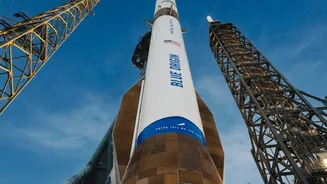
The recent launch of Blue Origin's colossal New Glenn rocket marked a pivotal advancement in spaceflight sustainability by incorporating previously utilized
hardware. This mission, designated NG-3, represented the rocket's third journey into orbit, but crucially, it was the first time a previously flown booster was integrated into its ascent. The colossal 322-foot tall rocket, surpassing SpaceX's Falcon 9 by a considerable 100 feet and matching NASA's Artemis II-bound Space Launch System in stature, successfully lifted off with a satellite payload. The impressive feat of reusing the rocket's first stage, which had previously served on the NG-2 mission, underscores a strategic move towards more economical and environmentally conscious space exploration. This achievement positions the company to more effectively contend within the competitive landscape of orbital launch providers, demonstrating a commitment to pushing the boundaries of reusability in heavy-lift rocketry.
Payload's Off-Nominal Orbit
While the rocket's booster successfully returned to Earth, touching down in the ocean as intended, the mission encountered unforeseen difficulties with its primary payload, BlueBird 7. The direct-to-cellphone internet satellite was scheduled for deployment approximately one hour and fifteen minutes post-liftoff. However, after a two-hour monitoring period, Blue Origin communicated via social media that payload separation had been confirmed, and the satellite had powered on. Nevertheless, a critical issue arose: the payload was placed into an 'off-nominal orbit.' This meant the satellite was not in its intended operational trajectory, prompting further investigation and assessment by the company. The situation highlighted the delicate balance required for successful satellite deployment, even when the launch vehicle performs flawlessly.
Satellite's Fate and Recovery
Following the launch, AST SpaceMobile, the entity behind the BlueBird 7 satellite, provided a clarifying statement regarding the payload's status. They confirmed that the satellite had successfully detached from the launch vehicle and had powered on as expected. However, the critical issue was its orbital altitude, which was determined to be too low for its onboard thruster technology to maintain sustained operations. Consequently, the satellite was slated for de-orbiting. The financial implications of this setback are expected to be mitigated, as AST SpaceMobile indicated that the cost of the satellite would be recovered under the company's insurance policy. This situation underscores the inherent risks associated with launching complex payloads, even when the launch vehicle itself operates perfectly.
Future Lunar Mission Impact
The successful reusability of the New Glenn booster on this mission also has implications for other upcoming Blue Origin endeavors. Specifically, the company's Mark 1 Blue Moon lander, slated for a crewless lunar mission by the end of summer, may face potential delays. While the lander has successfully completed vital environmental testing at NASA's Johnson Space Center in Houston, the unexpected orbital anomaly experienced by the BlueBird 7 satellite could necessitate a reassessment of launch schedules. The complexities and challenges encountered in deploying payloads to precise orbits, as evidenced by this mission, often require adjustments to broader launch plans, emphasizing the interconnected nature of space missions and the stringent requirements for lunar operations.