






The Call of the Wild
The air in Tadoba National Park buzzed with palpable excitement as dusk approached. A sharp, distinct bark, barely audible to the untrained ear, pierced
the evening stillness. For our guide, Santosh, it was a definitive sign, a confirmation of what he'd anticipated all afternoon. "The tiger is close, I assure you," he stated with quiet confidence. Our open-top Gypsy had been traversing the dense jungle for two hours with no luck, each stop yielding only the rustling of leaves and the distant calls of other creatures. As the sun dipped lower, we made our way to a waterhole, joining other vehicles filled with eager onlookers. We positioned ourselves, anticipating a majestic appearance from the opposite embankment. It was the deer's alarm call, echoing again from a new direction, that truly galvanized Santosh. "Quickly, drive!" he urged the driver, Atul, gesturing to reverse towards a road fork we'd passed. A silent, efficient race ensued among the five Gypsies, a testament to the drivers' skill, as they maneuvered back to a clearing surrounded by tall grasses and trees. Cameras poised, we waited, the anticipation thick in the air.
A Royal Encounter
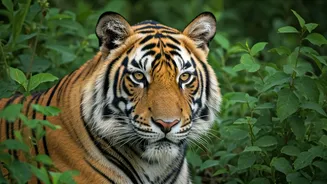
From the dense undergrowth, a stunning sight emerged: a magnificent cub, walking with an unperturbed, confident stride, unfazed by the cameras trained on her. Soon, her sister joined her, and the two playful siblings nuzzled each other, a picture of youthful feline grace. This was the moment every safari-goer had been waiting for, a chance to witness the sheer majesty of a tiger up close. The experience of seeing such a regal animal from a distance where every stripe and whisker was discernible was profoundly moving, sending shivers down the spine. The cubs, appearing to be around two to three years old, moved closer to the waiting vehicles, their presence commanding a hushed reverence. The only sounds were the rapid clicks of camera shutters, a testament to the awe-inspiring scene unfolding before us. Santosh explained that Tadoba's tigers are so accustomed to the presence of safaris that they perceive humans and their vehicles as an integrated part of the jungle's landscape.
Tiger Behaviour Insights
Santosh shared a valuable tip for future encounters: if a tiger makes eye contact, maintain a steady gaze without crouching, signalling that you are not prey. He identified the two cubs as offspring of Chhoti Madhu, a well-known tigress of Tadoba; cubs are named only upon reaching adulthood. Chhoti Madhu also has a third cub, a male, whom we did not see. We did, however, catch a fleeting glimpse of Chhoti Madhu herself, observing from a distance as her daughters played before heading to the waterhole. The local forest officer, Santosh Thipe, later informed us about other tigers inhabiting the area, including Shambu, Vaiman, Chhota Dadiyal, W, and Collar Wali. Thipe described the tiger as the most regal of jungle animals, possessing an aloof, dignified, and superior demeanor, akin to a king. He emphasized that a tiger's attack is solely driven by hunger, unlike humans, wild animals are not driven by greed and kill only for sustenance, a stark contrast to human behavior.
Tadoba's Wildlife Haven
Tadoba stands as one of India's 58 tiger reserves, widely celebrated for its remarkable success in tiger spotting. Located a manageable three-and-a-half-hour drive from Nagpur, the park offers various accommodation options in its buffer zone. Safari excursions are strictly timed, with four-hour slots in both the morning and afternoon, and visitors must exit the core area by 6 pm during winter, a rule rigorously enforced. Tourists can enter Tadoba through 23 different safari gates. In compliance with a recent Supreme Court directive, mobile phones are prohibited within Tadoba and many other national parks. The reserve is home to approximately 90 tigers, with the adjacent Tadoba Andhari Tiger Reserve supporting an additional 100. This population has seen significant growth, nearly tripling from just 30 tigers a decade ago. The Andhari River is vital to the reserve's abundant wildlife, which includes spotted deer, sambar deer, sloth bears, Indian gaur, wild dogs, leopards, crocodiles, and a variety of birds and other creatures.
Beyond the Tiger
A safari in Tadoba presents an invaluable opportunity to gain a deeper understanding of the diverse life forms that share our planet and to collect fascinating insights about India's national animal. For instance, one can observe how jungle cats employ tree trunks, bushes, and boulders to mark their territories with scent. Each tiger boasts a unique stripe pattern, a natural masterpiece best identified by the symmetrical markings on its flanks, a detail poet William Blake eloquently captured in his verse: 'Tyger Tyger, burning bright, / In the forests of the night: / What immortal hand or eye, / Could frame thy fearful symmetry?' This intricate beauty underscores the importance of preserving these magnificent animals and their habitat for future generations to admire and learn from.