
Black Holes Unveiled
Black holes, those enigmatic celestial bodies, continue to captivate scientists and the public alike. Recent research has brought forth exciting new information
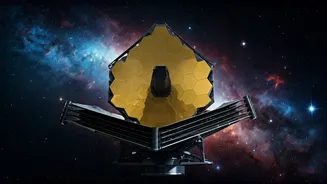
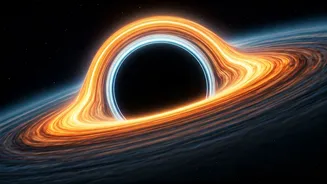
about these colossal objects, showcasing their profound impact on the universe. One of the most intriguing discoveries involves the detection of an enormous flare, a burst of energy emanating from a black hole that is as powerful as 10 trillion suns. This observation has provided astronomers with a unique opportunity to study the behavior of black holes, gaining insights into how they consume matter and interact with their surroundings. Moreover, advanced telescopes such as the James Webb Space Telescope (JWST) are providing unprecedented close-up views, helping to refine our understanding of these gravitational powerhouses. Furthermore, through analyzing X-ray images, scientists are able to study the intricate processes shaped by supermassive black holes located at the centers of galaxies.
Spacetime's Dance
Einstein’s theories, particularly those concerning gravity and spacetime, are being tested with fresh evidence from these cosmic phenomena. Scientists are witnessing firsthand how black holes can distort and manipulate the very fabric of spacetime. One remarkable observation showcases a black hole's ability to drag and twist spacetime, confirming Einstein’s predictions. In addition, the way black holes interact with the matter surrounding them offers intriguing insights. For example, some black holes are found to destroy stars, creating phenomena that challenge existing theories, and raise questions about their nature. The discovery of these events continues to drive advancements in astrophysics, as it encourages constant revisions and enhancements of our existing models, as scientists race to better understand the universe. Every new image and every data point adds another piece to the complex puzzle that explains these fascinating structures.
Galaxy Cluster Insights
Beyond individual black holes, scientists are now examining their influence within the larger galactic environment. By studying galaxy clusters, astronomers get a clearer understanding of how black holes influence their surroundings. Analyzing X-ray images, for instance, allows researchers to observe jet-blown bubbles and sound waves rippling through the hot gas in these clusters. These observations demonstrate how black holes regulate the activity within galaxies, affecting the formation of stars and overall galactic evolution. Furthermore, the JWST is proving pivotal in the process of exploring galaxies, as it spots rapidly feeding supermassive black holes in the ancient universe. These discoveries are helping astronomers connect the dots between individual objects and the large-scale structures that fill our cosmos, giving them a better picture of the entire evolution of the universe.
Future Discoveries
The future of black hole research looks promising, as telescopes and instruments improve, opening the door for even more spectacular discoveries. Ongoing research aims to explore the full extent of their influence within the universe. Scientists are preparing to unravel other mysteries that surround black holes. These include the long-standing question of how a supermassive black hole is activated. One theory that could explain the phenomenon involves the merger of two galaxies. With each new discovery, our understanding of these extreme objects deepens, reshaping the way we perceive the cosmos. Every finding is a piece of the puzzle that is yet to be completed, and each scientific breakthrough brings us closer to understanding the universe.