




Mission's Fiery Conclusion
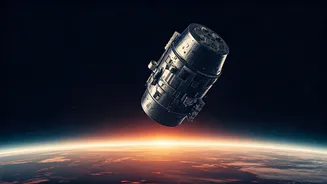
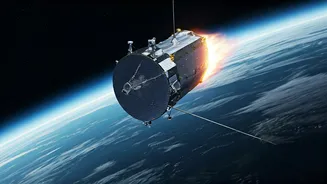
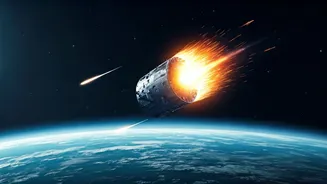
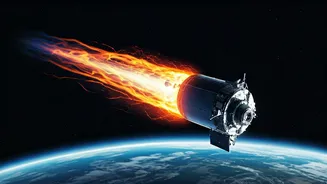
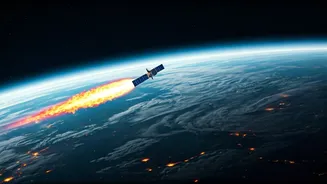
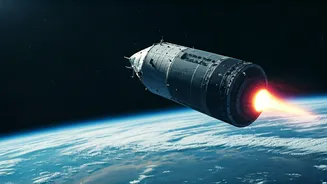
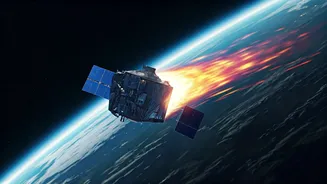
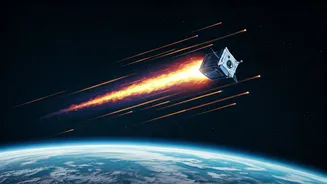
NASA's Van Allen Probe A, a substantial spacecraft weighing over 600 kg, has successfully concluded its extensive operational lifespan by re-entering Earth's
atmosphere. This event signifies the end of a mission that spanned nearly 14 years and significantly advanced our understanding of the Van Allen radiation belts. These belts, a crucial component of Earth's magnetosphere, act as a shield against harmful cosmic radiation and solar wind, safeguarding life on our planet and protecting vital technological infrastructure like satellites. The probe's re-entry, occurring on a Wednesday afternoon according to Indian Standard Time, was anticipated to result in most of the spacecraft burning up due to the intense heat and friction generated during its descent. While the majority was expected to disintegrate, NASA acknowledged the small possibility of some fragments surviving this fiery process, estimating the risk to the public as exceptionally low, with a one in 4,200 chance of any individual being harmed.
Extended Orbit & Fuel Depletion
Initially deployed in 2012 alongside its twin, Van Allen Probe B, the Van Allen Probes mission was conceived as a relatively short-term endeavor, originally slated for a two-year duration. However, the probes far surpassed their planned operational period, gathering critical scientific data for close to seven years. Their extended functionality allowed for a comprehensive study of the complex radiation environment enveloping Earth. The mission eventually drew to a close in 2019 not due to a failure, but because both spacecraft exhausted their fuel reserves. This depletion meant they could no longer maintain the precise orbital orientation required to keep their solar panels effectively tracking the Sun for power generation, thereby necessitating the end of their active data collection phase. The radiation belts themselves are named in honor of James Van Allen, the scientist credited with their initial discovery back in 1958.
Solar Activity's Influence
The timeline for Van Allen Probe A's re-entry into Earth's atmosphere was significantly impacted by an unforeseen surge in solar activity. Early projections made at the mission's conclusion suggested the spacecraft would likely remain in orbit until around 2034. However, these calculations were based on a less active solar cycle than what ultimately materialized. Researchers confirmed in 2024 that the Sun had reached the peak of its current solar cycle, a period known as solar maximum, which is characterized by heightened energetic events and increased solar wind output. This intensified solar activity led to a greater atmospheric drag on the spacecraft. As the Earth's upper atmosphere expanded due to the increased solar energy, it exerted a stronger pull on the probe, gradually causing its orbit to decay and accelerating its re-entry into the atmosphere much sooner than initially anticipated.
Key Mission Discoveries
The extensive data collected by the Van Allen Probes mission led to several pivotal scientific breakthroughs regarding Earth's magnetosphere. Perhaps one of the most groundbreaking discoveries was the identification of a transient, or temporary, third radiation belt. This additional belt was observed to form during periods of particularly intense solar activity, demonstrating the dynamic and sometimes complex nature of the space environment around our planet. While Van Allen Probe A has now completed its journey, its twin, Van Allen Probe B, is expected to continue its orbital path for several more years, with NASA predicting its re-entry will not occur before 2030, allowing for continued, albeit passive, observation.