
Istanbul's Grand Gateway
Istanbul Airport, a significant hub in Turkey, boasts a colossal single-structure terminal, Terminal 1, with ambitious expansion plans to solidify its
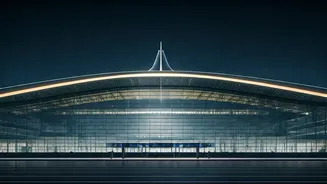
position among the world's elite. It currently stands as the largest privately operated airport globally and ranks as Europe's second busiest. This architectural feat is designed to accommodate the ever-increasing flow of air travelers, offering a glimpse into the future of air travel infrastructure. Its immense scale and strategic location make it a pivotal point for international transit, reflecting the dynamic growth of aviation and the continuous pursuit of enhanced passenger experiences.
Beijing's Starfish Terminal
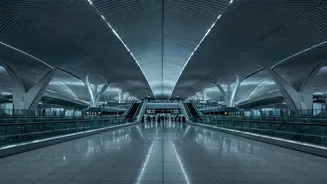
Beijing Daxing International Airport (PKX) in China is a marvel of modern engineering, recognized as the largest airport building worldwide under a single roof. Its striking 'starfish' design encompasses a staggering 700,000 square meters of floor space, an area roughly equivalent to 97 football fields. Completed in June 2019 and operational by September 2019, this terminal represents a significant leap in airport design, prioritizing efficiency and passenger flow. Its sheer size and innovative layout aim to streamline the travel experience for millions of passengers passing through China's capital.
Dubai's Former Record Holder
Dubai International Airport's Terminal 3 in the UAE once held the prestigious title of the largest airport building globally, spanning an impressive 1,185,000 square meters. Although Beijing Daxing is now more commonly cited as the largest modern single-roof structure, Terminal 3 remains a monumental testament to ambitious construction. Opened in October 2008, it was a groundbreaking achievement in airport infrastructure, designed to handle immense passenger volumes. Its sheer scale and the facilities it houses underscore Dubai's commitment to becoming a premier global aviation hub, even as architectural records continue to be set.
Shanghai's Satellite Hub
Shanghai Pudong International Airport (PVG), serving the bustling metropolis of Shanghai, China, features a notable satellite terminal that ranks among the largest airport structures in the world. This satellite facility alone covers approximately 622,000 square meters, contributing significantly to the airport's overall capacity. PVG, which commenced operations in October 1999, is not only a major passenger hub but also the world's second-busiest airport for cargo traffic, highlighting its multifaceted importance in global logistics. It stands as China's busiest airport and a significant player in Asian and global air traffic rankings.
Jeddah's Hajj Facilitator
King Abdulaziz International Airport (JED) in Saudi Arabia plays a crucial role in facilitating travel for pilgrims visiting Mecca and Medina, with its Terminal 1 being one of the largest single airport buildings designed to manage this high passenger volume. This terminal is specifically engineered to handle an annual passenger capacity of 30 million, with forward-thinking plans to potentially expand this to 80 million. Its strategic importance for Hajj travel makes it a vital piece of infrastructure, ensuring a seamless and efficient experience for millions of religious visitors each year.
Kuala Lumpur's Spacious Design
Kuala Lumpur International Airport (KUL) in Malaysia is characterized by its expansive main terminal and a substantial satellite terminal, both contributing to its impressive overall footprint. Terminal 1, inaugurated in 1998 and designed by the acclaimed Japanese architect Kisho Kurokawa, exemplifies thoughtful urban planning. While its name suggests proximity to the capital, the airport is strategically situated in the Sepang District of Selangor. This vast complex is designed to handle significant passenger traffic, embodying a blend of functional design and architectural vision within Malaysia's transportation network.
Abu Dhabi's Modern X-Shape
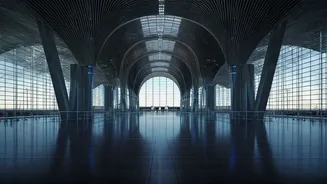
Abu Dhabi International Airport, now known as Zayed International Airport, has unveiled its spectacular Terminal A, a vast, X-shaped structure that represents the pinnacle of modern airport design. This impressive facility, which began operations in November 2023, is built to accommodate up to 45 million passengers annually and covers an immense 780,000 square meters. Its sheer scale is further emphasized by its reported capacity to simultaneously house 79 Airbus A380-type aircraft, showcasing its state-of-the-art capabilities and positioning it as one of the world's largest and most advanced airport terminals.