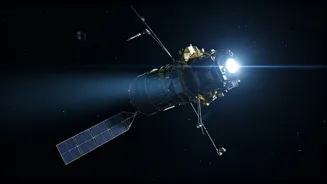





NASA has strategically powered down a crucial instrument on the Voyager 1 spacecraft, a move designed to conserve dwindling energy reserves. This decision
allows the probe to continue its groundbreaking journey through interstellar space, extending its valuable data collection mission.
Voyager's Deep Space Role
Launched in 1977, Voyager 1 has transcended its initial planetary exploration mandate, becoming the most distant human-made object. Its current, pivotal role involves providing unprecedented insights into interstellar space, the region far beyond the Sun's direct influence, known as the heliosphere. Alongside its twin, Voyager 2, it is the sole conduit for direct information from this largely uncharted cosmic frontier. The data it transmits is invaluable for understanding the conditions and phenomena present in this extreme environment, making its continued operation a scientific imperative. The probe travels at a remarkable speed, pushing further into the unknown with every passing moment, a testament to human ingenuity and our insatiable curiosity about the universe.
The Power Predicament
The fundamental driver behind the recent instrument shutdown is the critical depletion of Voyager 1's power supply. The spacecraft relies on a radioisotope thermoelectric generator (RTG), which converts heat from decaying plutonium into electricity. This power source has been steadily diminishing since the mission's inception, with an estimated loss of about 4 watts annually. Without proactive measures like this instrument deactivation, the probe risked encountering its automatic fault protection system, which could disable multiple critical components simultaneously, making future recovery efforts exponentially more challenging. This strategic decision is about carefully managing resources to ensure the longevity of a mission that has already exceeded all expectations.
Instrument's Long Service
The specific instrument now offline is the low-energy charged particles experiment (LECP), a veteran that has been diligently gathering data almost continuously since Voyager 1's launch in 1977. For nearly five decades, the LECP has been instrumental in studying ions, electrons, and cosmic rays originating from both within and outside our solar system. Its findings have significantly contributed to our understanding of the region beyond the heliosphere, including the detection of pressure waves and shifts in particle density. While its scientific contributions have been immense, shutting down the LECP was deemed essential to preserve the overall mission's operational capability and ensure its continued presence in interstellar space for future discoveries.
A Calculated Strategy
This shutdown was not an impromptu decision but rather a carefully orchestrated maneuver, part of a long-term strategy designed to gradually phase out instruments as power levels decline. Each Voyager spacecraft was initially equipped with ten instruments, and most have already been deactivated over the years as part of this phased approach. The LECP was the next logical component to be powered down, following a similar procedure planned for Voyager 2 in 2025. The immense distance of Voyager 1, now over 15 billion miles from Earth, further complicates operations; it takes approximately 23 hours for commands to reach the spacecraft, adding considerable time to any planned actions, including this recent shutdown which took several additional hours to complete.
Mission Continues, Future Plans
Despite the deactivation of the LECP, Voyager 1's scientific mission is far from over. Two vital instruments remain fully operational, continuing to send back invaluable data on plasma waves and magnetic fields from the interstellar medium. Intriguingly, a small, low-power component of the LECP has been kept active, preserving the potential for its reactivation should sufficient energy become available in the future. Furthermore, engineers are actively developing an innovative plan, informally dubbed the “Big Bang,” to maximize the spacecraft's remaining power. This initiative involves replacing power-intensive components with more energy-efficient alternatives. Initially slated for testing on Voyager 2, this advanced strategy, if successful, could significantly extend Voyager 1's operational lifespan by at least a year and potentially enable the revival of other systems down the line.