





Moon Dust to Oxygen
Venturing into the cosmos presents astronauts with immense challenges, chief among them the scarcity of breathable air. Unlike Earth, the Moon lacks the trees
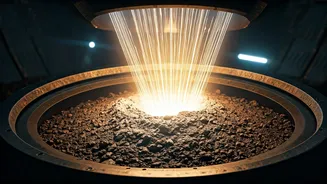
and organic life that naturally produce oxygen. However, NASA's recent Carbothermal Reduction Demonstration (CaRD) program has unveiled a remarkable solution: transforming the Moon's own soil, known as lunar regolith, into vital oxygen. This ambitious project successfully tested a prototype system that harnesses concentrated solar energy to achieve this feat. While the experiment was conducted in a simulated lunar environment, it served as a crucial proof of concept, demonstrating the viability of in-situ resource utilization for future lunar missions. The core of this technology is a carbothermal oxygen production reactor, which heats lunar regolith to melting point. It then introduces carbon to react with silicate minerals, producing carbon monoxide gas. This gas is subsequently captured and processed to yield breathable oxygen. This method marks a significant advancement, as CaRD is the first to validate this process within a highly representative simulated lunar setting, moving beyond purely laboratory-based theoretical approaches.
Fueling Future Exploration
The implications of the Carbothermal Reduction Demonstration (CaRD) program extend far beyond providing simple breathable air for lunar inhabitants. NASA anticipates that when scaled up, the carbothermal oxygen production reactor technology could generate oxygen in quantities several times its own weight annually. This capability is fundamental for establishing and sustaining long-term human settlements on the Moon, ensuring a continuous supply of life-support resources. Furthermore, the oxygen extracted from lunar regolith isn't solely for breathing; scientists envision its use as a potent propellant for spacecraft. The potential exists for a lunar outpost to function as a refueling station, allowing missions to replenish their fuel supplies using locally sourced materials. This self-sufficiency drastically reduces the logistical burden of supplying propellants from Earth, making deep space exploration more feasible and cost-effective. The CaRD program's success has ignited imaginations about creating a robust lunar infrastructure capable of supporting a variety of spacefaring activities.
Beyond Oxygen: Water & Methane
The innovative carbothermal reduction process isn't limited to oxygen extraction; its potential applications are remarkably diverse. The term 'regolith' is not exclusive to the Moon; it also applies to the soil found on other celestial bodies, including Mars. This means that a carbothermal oxygen production reactor could theoretically be adapted to transform Martian rocks into oxygen, a critical step towards future colonization efforts there. Even more excitingly, scientists can fine-tune the reaction to simultaneously produce other essential resources, such as water and methane. Water is fundamental for life support and can also be electrolyzed to produce hydrogen and oxygen, both vital for propellant. Methane itself is a powerful rocket fuel. NASA is also confident in its ability to use electrolysis on lunar regolith to create water, which can then be converted into methane. This opens up possibilities for Mars missions where finding indigenous water might not be a prerequisite for human settlement, thanks to adaptable terrestrial technologies.