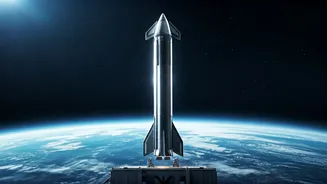








Starship's Next Chapter
SpaceX's ambitious project, the Starship megarocket, is on the verge of its 12th test flight. This massive rocket, comprised of the Super Heavy booster
and the Starship itself, is designed to be fully reusable, aiming to revolutionize space travel. The stacking of the Super Heavy booster is a visible sign of the preparations, hinting at the complexity and scale of the upcoming launch. Each test flight is a chance to refine the technology, pushing the boundaries of what is possible in space. The success of Starship is critical for future missions, potentially including travel to Mars and beyond. This test flight will be a crucial step in validating the design and engineering behind this groundbreaking spacecraft. It highlights SpaceX's commitment to innovation and its goal of making humanity a multi-planetary species.
NASA's Early Return
In a separate development, NASA recently faced a unique challenge on the International Space Station (ISS). For the first time ever, the agency initiated a medical evacuation for 4 astronauts, bringing them home earlier than planned. This situation underscores the critical role of medical support in space and highlights the ongoing efforts to ensure the health and safety of astronauts. The specifics of the medical issue haven't been widely disclosed, but the quick response and action demonstrate NASA's commitment to prioritizing the well-being of its crew. This experience also provides valuable insights for future long-duration space missions, emphasizing the need for robust in-flight medical capabilities to handle unexpected health challenges far from Earth.
China's Lunar Missions
China is making significant strides in its lunar exploration program, with the Chang'e 7 mission set to launch this year. The primary objective of Chang'e 7 is to search the lunar south pole for water ice. The discovery of water ice would be a game-changer, potentially providing resources for future lunar bases and missions. Simultaneously, the Tianwen 2 spacecraft is on its way to a mysterious 'quasi-moon' asteroid, having already sent back its first images. The exploration of asteroids can offer vital insights into the early solar system. China's lunar and asteroid exploration programs reflect its commitment to becoming a leading spacefaring nation. These endeavors are contributing to a deeper understanding of the solar system's origins, and also driving advancements in space technology.









![[WATCH] 'Real Madrid, Ramadan and rest' - Mohammed Siraj how last-minute World Cup call-up changed February plan](https://g-mob.glance-cdn.com/public/fc/image/ByYT_LEmlrD0.webp)