






Zircon: Earth's Ancient Gemstone
Zircon boasts an incredibly rich history, being one of the oldest minerals found on our planet, with some specimens dating back over four billion years.
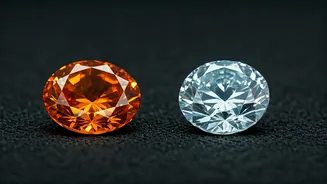
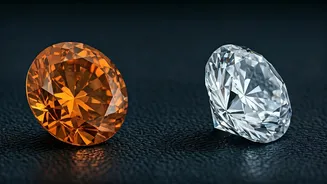
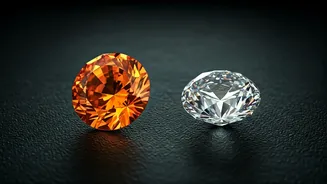
Chemically identified as zirconium silicate, this natural gemstone possesses a remarkable visual appeal due to its high refractive index, which allows it to capture and reflect light with a dazzling, diamond-like sparkle. A unique characteristic of zircon is its double refraction; when light enters the stone, it splits into two distinct rays, often making the back facets appear doubled when observed closely, a phenomenon not found in diamonds. While the colorless variety is frequently chosen as an affordable substitute for diamonds, zircon also occurs in a spectrum of earthy hues, including yellow, brown, and red. Furthermore, through heat treatment, it can be transformed into a striking blue gem. However, zircon is not as robust as some other gemstones, with a Mohs hardness rating between 6.5 and 7.5, making it susceptible to chipping if subjected to impact.
American Diamond: The Lab-Created Sparkler
In India, the term "American diamond" commonly refers to cubic zirconia (CZ), a synthetic gemstone meticulously crafted in laboratories to emulate the appearance of a natural diamond. Unlike zircon, cubic zirconia has no ties to natural geological processes; it is produced under controlled laboratory conditions using zirconium dioxide. This controlled creation process ensures that cubic zirconia is almost invariably flawless, lacking any internal inclusions or surface imperfections. Its interaction with light differs significantly from zircon, exhibiting single refraction which results in a sharp, clean sparkle. It is also renowned for its pronounced 'fire,' characterized by vibrant rainbow flashes that are more intense than those seen in real diamonds. While its brilliance can sometimes appear excessive, cubic zirconia excels in durability, possessing a Mohs hardness of 8 to 8.5, making it more resilient than zircon and well-suited for daily wear. Its affordability, driven by efficient mass production, has cemented its popularity in artificial jewelry.
Key Distinctions: Origin to Wearability
The confusion between Zircon and American Diamond (cubic zirconia) is widespread, even among those in the jewelry trade. While both are admired for their ability to mimic the allure of real diamonds without the exorbitant cost, their resemblances are superficial. Their fundamental differences lie in their origins—one is a gift from the earth, the other a product of human ingenuity. Chemically, they are distinct compounds, and their optical properties, which dictate how they interact with light and appear to sparkle, are entirely unique. Zircon's double refraction creates a different kind of visual depth compared to the sharp, singular brilliance of cubic zirconia. Furthermore, their physical resilience varies considerably; the lab-created cubic zirconia offers superior hardness and durability for everyday adornment, whereas natural zircon, though beautiful, is more prone to wear and tear. Understanding these disparities is crucial for consumers seeking to make informed choices about the jewelry they purchase.