





Solar Winds Fueling Displays
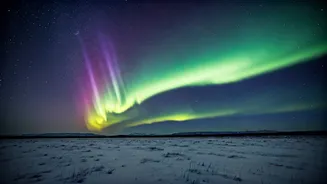
The mesmerizing spectacle of the aurora borealis, often called the Northern Lights, is a direct result of the Sun's activity. Charged particles, primarily
electrons and protons, are constantly streaming from the Sun in what's known as the solar wind. When this solar wind interacts with Earth's magnetic field, it can create breathtaking auroral displays. The speed and density of these solar winds are critical factors. Faster solar winds, often originating from coronal holes (regions on the Sun where the magnetic field lines are open), can deliver a more energetic particle stream towards our planet. This increased energy can intensify the interaction with our magnetosphere, leading to more vibrant and widespread auroras. Analyzing these solar wind characteristics is a key component of aurora forecasting, helping skywatchers anticipate when conditions might be favorable for a viewing.
Geomagnetic Storms and Auroras
The Earth's magnetic field acts as a protective shield, but it can be temporarily disturbed by intense solar activity, leading to geomagnetic storms. These storms occur when a significant influx of charged particles from the Sun, often from Coronal Mass Ejections (CMEs) or high-speed solar wind streams, overwhelms the magnetosphere. During a geomagnetic storm, the charged particles are channeled towards the Earth's magnetic poles. As these particles collide with gases in the upper atmosphere—primarily oxygen and nitrogen—they excite these gases, causing them to emit light in the form of auroras. The intensity of a geomagnetic storm, often categorized by the Kp-index, directly correlates with the auroral visibility. Higher Kp values indicate stronger storms, which can push the auroral oval further south, making the Northern Lights visible at lower latitudes than usual, sometimes even in regions like Italy or Illinois during particularly powerful events.
Forecasting the Lights
Predicting the aurora borealis involves monitoring several key space weather phenomena. Forecasters analyze data from satellites and ground-based observatories to track solar wind speed and density, the Bz component of the interplanetary magnetic field (which indicates the orientation of the magnetic field relative to Earth's), and the likelihood of CMEs impacting Earth. When a CME is detected heading towards our planet, or when high-speed solar wind streams are identified, there's an increased chance of geomagnetic storms and, consequently, auroras. Aurora forecasts often provide information about expected geomagnetic activity levels (e.g., minor G1 storms to severe G4 storms), the potential visibility range (primarily high latitudes, but sometimes extending to mid-latitudes), and the timing of these events. Staying updated on these forecasts allows enthusiasts to maximize their chances of witnessing this celestial phenomenon.