







A New Power Source
The energy landscape is undergoing a significant transformation, with major technology firms heavily investing in nuclear power and exploring alternative
solutions to fuel their expansive data centers. In a notable development earlier this year, a prominent tech company revealed ambitious plans for a new data center in Minnesota. While many companies are currently focusing on nuclear energy, this particular firm has also diversified its investments into other energy-related ventures, including an intriguing new battery system that surprisingly harnesses rust for power generation. This innovative battery technology is emerging from a company named Form Energy, promising a novel way to deliver electricity.
Iron-Air Battery Explained
The battery technology in question is developed by Form Energy and is designed to supply a substantial 300 megawatts of electricity, capable of running for an impressive 100 hours. This system is referred to by the company as an "iron-air battery." Its unique mechanism involves "breathing" in oxygen as it generates electricity. Beyond its novel design, Form Energy asserts that this battery represents the "largest battery project by gigawatt-hour energy capacity announced to date in the world." This massive capacity is set to integrate with existing clean energy initiatives, such as the plans by Google and Xcel Energy to introduce 1,900 megawatts of renewable power to the Minnesota grid, combining wind, solar, and this advanced long-duration energy storage solution.
The Rust Revolution
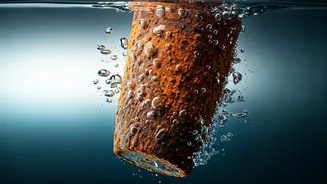
What truly sets this new battery design apart from Form Energy is its ingenious use of readily available materials, eschewing lithium and other scarce resources. Instead, it relies on the fundamental elements of iron, air, and water, which, through a clever process, combine to produce an abundance of rust. The core principle appears to be the utilization of reversible rusting. Form Energy has devised a system that leverages the natural process of oxidation. Rather than simply being a byproduct, the rust formed during the battery's discharge cycle is integral to its operation. The battery is engineered to absorb air while releasing electrical energy. This process leads to the oxidation of iron, transforming it into rust.
Reversible Rusting Cycle
When the battery's energy reserves are depleted and it requires recharging, an electrical current is applied. This current facilitates the transformation of the rust back into usable iron. Crucially, this process also releases oxygen back into the atmosphere. This cyclical nature allows the battery to repeatedly utilize the same core materials, eliminating the need for rare elements like lithium. It even bypasses the reliance on sodium, a material that has recently gained traction as a potential substitute for lithium. The overarching goal is to provide a clean energy solution that taps into natural processes, offering a more secure method for energy storage by avoiding flammable components.
Massive Scale Storage
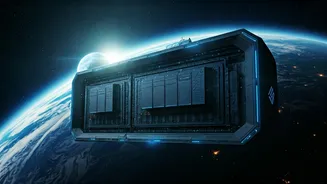
While the underlying science is remarkable, the physical manifestation of these batteries is substantial. The individual cells are reportedly housed within enormous enclosures, some reaching the dimensions of a shipping container. Although this considerable size might not be ideal for all applications, it is well-suited for the demands of large-scale operations such as data centers. This development is particularly noteworthy as an increasing number of companies are exploring next-generation energy solutions, including nuclear facilities. However, systems like the one developed by Form Energy present a cleaner, more accessible pathway to augmenting our energy supply.