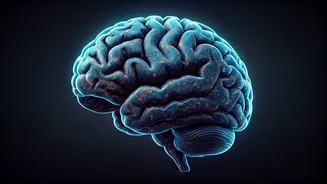








The Brain's Familiarity Bias
Australian psychologist Millie Hardie reveals a crucial insight: our brains are not impartial observers but rather sophisticated pattern-recognition machines.
What we repeatedly tell ourselves, even unconsciously, becomes familiar, and the brain actively reinforces this familiarity. This process isn't merely cognitive; it has a tangible, physical impact on our neural pathways. Over a decade of study has led Hardie to emphasize that this internal dialogue serves as a foundational blueprint for our entire experience of life. Thoughts directly influence emotions, which in turn dictate our actions, and these actions collectively shape our sense of self. Therefore, the constant stream of internal chatter is not inconsequential background noise but a powerful architect of our mental landscape and our perception of ourselves.
The Power of Internal Dialogue
The pervasive nature of 'hustle culture' often leads us to dismiss our internal monologues as insignificant. However, Hardie strongly challenges this notion, explaining that self-talk, particularly when infused with emotion and repeated frequently, actively rewires the brain. This isn't just a bad habit; it's a profound form of mental programming. When we consistently engage in self-criticism or negative self-talk, our neural networks begin to form pathways that solidify these detrimental beliefs. This constant internal reinforcement means that the way we speak to ourselves directly translates into how we feel about ourselves, ultimately influencing our broader life experiences and outcomes. Your life, Hardie suggests, often becomes a mirror reflecting your deeply ingrained self-perception.
Visualisation as Mental Rehearsal
While the implications of negative self-talk are concerning, the principle of neuroplasticity also offers a powerful avenue for positive change and mental wellness. Hardie highlights that our brains possess a remarkable inability to fully distinguish between experiences that are real and those that are vividly imagined. This fascinating characteristic means we can leverage visualization as a potent tool for personal growth. By consciously picturing yourself as calm, confident, and capable, you are not engaging in mere fantasy; you are actively rehearsing these desired states. This mental rehearsal helps to forge new neural pathways, making these positive attributes more familiar and thus more accessible in your actual life, directly contributing to a more resilient and empowered mindset.
Curating Your Mental Landscape
One of the most empowering aspects of understanding neuroplasticity is the ability to detach from intrusive thoughts and regain a sense of agency over one's mind. Hardie encourages us to view our thoughts as transient visitors rather than as definitive truths or extensions of our identity. You are not inherently bound to believe every thought that arises; you are the observer, capable of choosing which ideas to entertain and which to let pass. By adopting this perspective, individuals can begin to actively curate their mental environment, fostering a healthier internal space. The fundamental principle for enhancing mental health, as championed by Hardie, is straightforward yet deeply impactful: by consciously altering the input—the self-talk and the thoughts we engage with—we can fundamentally change the output, leading to improved outcomes and greater well-being.