








A Dish of Many Layers
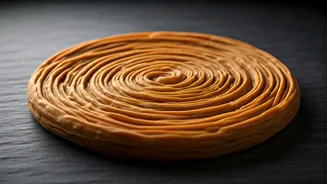
The Malabar parotta, a celebrated culinary delight often associated with Kerala, boasts a history as complex and layered as its flaky texture. While it's
an unofficial staple and a beloved dish for many, its true origins are not firmly rooted in the southern Indian state. This iconic flatbread, known for its soft interior and crisp, separated layers, has sparked considerable debate and several intriguing theories regarding its inception. It's a dish that has transcended regional boundaries, becoming a testament to the fluid nature of culinary traditions and how food travels across cultures and continents, often leaving a trail of delicious mystery behind. Its widespread appeal and consistent popularity today are a testament to its adaptability and the enduring fascination with its unique preparation and delightful taste, prompting a deeper look into its fascinating, non-linear journey.
The Sri Lankan Famine Theory
One of the most prevalent theories suggests that the Malabar parotta's lineage traces back to Jaffna, Sri Lanka, during the 1940s. At this time, a severe famine gripped Travancore, the southern region of Kerala, leading to significant hardship and loss of life. During this period, fishermen from Kerala frequently traveled to Jaffna. It's believed that these sailors encountered a layered flatbread known as 'Veechu parotta' in Sri Lanka, a light and flaky creation made from maida (refined wheat flour). Coincidentally, this was also a time when the British administration in India was promoting wheat-based foods. The sailors are thought to have brought this Sri Lankan recipe back to Kerala, where it gradually gained traction. Initially sold at street-side food stalls, or 'thattukadas,' the bread eventually earned the name 'Malabar parotta' not because of its place of origin, but due to its immense popularity and widespread adoption in the Malabar region of Kerala.
Arab Traders' Influence
Another compelling perspective, offered by culinary anthropologist Kurush Dalal, questions the inherent Keralan origin of the parotta, noting that wheat cultivation is not extensive in Kerala. This raises the question of why Kerala's most iconic bread heavily relies on maida. Dalal posits that the parotta, and perhaps even Sri Lanka's parotta tradition, may have arrived via Arab traders and sailors from West Asia. Through ancient maritime trade routes, these seafaring merchants could have introduced the technique of creating laminated, layered flatbreads. If this theory holds true, it implies that the fishermen who brought the 'Veechu parotta' back from Sri Lanka might have been, in essence, reacquainting themselves with a culinary practice that had already been introduced to the region centuries prior by Arab traders. This suggests a much older and more extensive history for layered flatbreads in the Indian Ocean region.
The North Indian Connection
A third theory posits a connection to North India, specifically to the 'lachha paratha.' For many who grew up in northern parts of India, lachha paratha is often the first encounter with a layered, flaky flatbread. The visual and textural similarities between lachha paratha and Malabar parotta are undeniable, leading some to believe that the latter is a southward evolution of the former. This theory suggests that over centuries, through migration and trade, the lachha paratha made its way down the subcontinent, eventually finding a home and evolving into its current form within the Madras Presidency and subsequently Kerala. While this theory is intuitively appealing due to the shared characteristics of the breads, it is generally considered the least historically substantiated among the various origin stories of the Malabar parotta.
Global Culinary Journey
The migratory journey of the parotta did not conclude at the borders of Kerala. The delicious, layered flatbread continued its global spread, carried by traders to Southeast Asian countries like Malaysia and Singapore. In these regions, it evolved into what is now known as 'roti canai,' a beloved staple that shares the fundamental characteristics of its Keralan ancestor – flakiness and multiple layers. Today, variations of this same delightful bread can be found in numerous places around the world, showcasing how a single culinary innovation can adapt and thrive in diverse cultural settings. Despite the proliferation of these different versions and the compelling theories surrounding its history, pinpointing a single, definitive origin story for the Malabar parotta remains challenging due to a scarcity of documented historical records. Nevertheless, its enduring appeal and presence across continents underscore its significance as a truly international culinary phenomenon.