
Gibbon's Canopy Leap
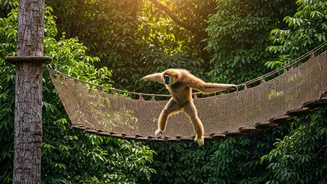
In a groundbreaking observation at Assam's Hollongapar Gibbon Sanctuary, a Western Hoolock Gibbon was recorded using an artificial canopy bridge for the
first time globally. This remarkable feat highlights the species' adaptability and the critical role of such infrastructure in maintaining wildlife corridors. The Hoollongapar Gibbon Sanctuary, a vital evergreen forest in Jorhat district, is a sanctuary for India's only gibbon species and the Bengal slow loris, Northeast India's sole nocturnal primate. The sanctuary, established and later renamed, introduced its first artificial canopy bridge in 2015. However, the initial design of this rigid iron structure proved unsuitable for the gibbons' specialized brachiation, a form of arboreal locomotion where they swing from branch to branch. This incident underscores the challenges faced by arboreal species whose movement is often interrupted by linear infrastructure like roads and railways, leading to habitat fragmentation and population isolation. The successful use of the bridge signifies a positive step towards mitigating these challenges and ensuring the survival of these unique primates.
RBI's Record Surplus
The Reserve Bank of India (RBI) has authorized a substantial transfer of Rs 2,86,588 crore to the Central Government for the fiscal year 2025-26, significantly bolstering the nation's financial resources. This impressive surplus is largely attributable to the RBI's strategic intervention in the foreign exchange market, where it sold considerable volumes of US dollars to counteract the rupee's persistent depreciation, thereby generating substantial trading gains. Concurrently, the RBI has fortified its financial resilience by increasing its contingency risk buffer (CRB) to Rs 109,379 crore. This buffer acts as a crucial financial safeguard, designed to absorb unforeseen risks stemming from geopolitical instabilities, fluctuations in crude oil prices, currency volatility, interest rate shocks, market losses, and operational challenges. The determination of this transferable surplus was guided by the central bank's revised Economic Capital Framework (ECF), approved by its Central Board. The ECF offers the flexibility to maintain the CRB within a range of 4.5% to 7.5% of the RBI's balance sheet size, with the current allocation set at 6.5%. This framework builds upon recommendations made by the RBI's Technical Committee in 2013, which had advocated for a greater surplus transfer to the government.
Diplomatic Engagements
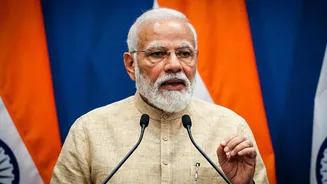
Prime Minister Narendra Modi's recent international visits have yielded significant diplomatic and economic outcomes. During his tour, he was bestowed with Sweden's 'Royal Order of the Polar Star, Degree Commander Grand Cross,' a highly distinguished honor instituted in the 18th century, making him the first Asian leader to receive this accolade. This award recognizes exceptional public service and contributions to strengthening bilateral relations. India and Sweden elevated their relationship to a Strategic Partnership, agreeing on a Joint Action Plan 2026-2030 built on four pillars: Strategic Dialogue for Stability and Security, Next-Generation Economic Partnership, Emerging Technologies and Trusted Connectivity, and Shaping Tomorrow Together (People, Planet, and Resilience). A bilateral summit, 'India-Sweden: Stronger Together – towards 2047,' is slated for 2027 in India. Furthermore, PM Modi's visit to the Netherlands resulted in the elevation of bilateral ties to a 'Strategic Partnership' through a five-year roadmap (2026-2030). Seventeen pacts were signed across crucial sectors like semiconductors, critical minerals, migration, water management, and renewable energy. A significant agreement was the MoU between Tata Electronics and ASML for supporting a semiconductor fab facility in Gujarat, leveraging ASML's unique position as the sole producer of essential EUV lithography machines for advanced semiconductor manufacturing. In Italy, relations were elevated to a 'Special Strategic Partnership.' Key outcomes included the creation of INNOVIT India, an innovation hub to foster collaboration, and the launch of a 'Dialogue on Maritime Security.' An MoU was also signed for Italy's participation in developing India's National Maritime Heritage Complex in Lothal and another for cooperation in critical minerals.
India's International Connections
India's global engagement continues to strengthen through strategic partnerships and economic collaborations. The India-Nordic Summit, the third of its kind, saw leaders from India, Norway, Sweden, Denmark, Finland, and Iceland convene to discuss mutual interests. Previous summits were held in Stockholm (2018) and Copenhagen (2022), highlighting a unique engagement level comparable to the US-Nordic dialogue. The trade volume between India and Nordic countries reached $19 billion in 2024. A notable development is the successful completion of final deliverable configuration development trials for the UAV-Launched Precision Guided Missile (ULPGM)-V3 by the Defence Research and Development Organisation (DRDO). Tested in both air-to-ground and air-to-air modes, this advanced missile features a high-definition dual-channel seeker and an intelligent guidance system incorporating multiple sensors for precise target tracking, effective against various threats. Its operational capabilities extend to day-and-night engagement in diverse terrains, supported by a two-way data link allowing real-time target updates. The missile can be armed with three types of warheads, making it a versatile asset for both stationary and moving targets under all weather conditions. This advancement underscores India's growing prowess in indigenous defense technology.
Places in the Spotlight
Several significant locations have recently garnered attention for their historical, environmental, or developmental importance. The Afsluitdijk dam in the Netherlands, a 32-kilometer marvel of water management, was visited by Prime Minister Narendra Modi. This iconic structure, a global benchmark for flood control and land reclamation, separates the North Sea from a freshwater lake, protecting low-lying regions and enabling freshwater storage. A Letter of Intent was signed between India's Ministry of Jal Shakti and the Netherlands' Ministry of Infrastructure and Water Management for technical cooperation on Gujarat's Kalpasar Project, which envisions a dam across the Gulf of Khambhat for freshwater storage, tidal power, irrigation, and transportation. In Rome, Prime Minister Modi and Italian counterpart Giorgia Meloni visited the Colosseum, the world's largest standing amphitheater, built in 80 AD and capable of holding up to 50,000 spectators. Declared a UNESCO World Heritage Site, its architectural grandeur is a testament to Roman engineering. Meanwhile, in Jharkhand, the Saranda forest division, known as 'seven hundred hills,' is at the center of a prolonged debate over its designation as a wildlife sanctuary. Despite Supreme Court directives, the Jharkhand government's resistance has led to repeated rebukes, highlighting the challenges in balancing conservation efforts with governance. Saranda is a biological hotspot, home to elephants, dense sal trees, and crucial elephant corridors, yet faces habitat degradation.
Cultural Insights and Awards
India's rich cultural tapestry was showcased through unique diplomatic gifts, while international accolades recognized literary achievements. During his five-nation tour, Prime Minister Modi presented exquisite Muga silk and Shirui Lily silk stoles from Assam and Manipur to Italian Prime Minister Giorgia Meloni, reflecting the artisanal excellence of these regions. For Queen Máxima of the Netherlands, a pair of Meenakari and Kundan earrings from Rajasthan, blending traditional artistry with symbolic colors representing the Dutch royal family and their connection to water, were gifted. Prime Minister Jonas Gahr Støre of Norway received a pressed orchid painting and paperweights from Sikkim, while Norwegian King Harald V was presented with an intricate silver sailboat model, a masterpiece of Tarakasi (silver filigree) art from Cuttack, Odisha. The UAE President was gifted a Rogan painting featuring the 'Tree of Life,' a significant art form from Gujarat symbolizing interconnectedness and renewal. In the realm of literature, 'Taiwan Travelogue' by Yáng Shuāng-zǐ, translated by Lin King, made history by winning the 2026 International Booker Prize. This marked the first time a book translated from Mandarin Chinese received this prestigious award, with Yáng and King becoming the first Taiwanese and Taiwanese-American winners. The £50,000 prize, split equally between author and translator, celebrates global literary talent.