
A Record-Breaking Achievement
Researchers from Soochow University and Xi'an Jiaotong University, in collaboration, have made a significant leap in solar technology. Their efforts resulted
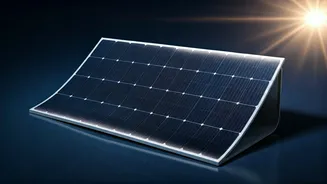
in a certified efficiency of 33.4% on small-area devices and 29.8% on commercial-size flexible panels. This achievement marks the first world record for flexible crystalline technology certified by international bodies. The development of flexible panels opens doors for solar power in previously inaccessible locations, potentially revolutionizing how we utilize solar energy. The innovative design allows these panels to bend repeatedly while maintaining near-30% efficiency. Furthermore, each panel weighs less than 4.4 grams, boasting an impressive power-to-weight ratio of 1.77 watts per gram. The team's research highlighted the potential of combining silicon and perovskite materials to capture more sunlight efficiently, a key element of their success. This technology paves the way for new applications in diverse environments and settings.
The Science Behind Flexibility
Traditional solar panels are typically made with rigid silicon wafers ranging from 120 to 200 micrometers thick. However, the researchers discovered that reducing the silicon's thickness to just 60 micrometers enabled it to bend without cracking, even with a small radius of curvature (less than two centimeters). This thinner design is a critical aspect of the panels' flexibility. The innovation also tackles the challenge of preventing the perovskite layers from separating during repeated bending. The team's solution was to design a double buffer layer. This buffer layer acts like a spring mattress to absorb stress, combined with a denser layer to ensure efficient charge extraction. The combination of these technologies has paved the way for flexible and durable solar panels ready for varied applications. The new approach promises high performance and long-term durability in different environments.
Wider Applications Unveiled
The introduction of flexible solar panels unlocks several possibilities for cost-saving measures. Companies operating delivery fleets, for instance, could potentially power their vehicles using roof-mounted, flexible solar panels, ultimately reducing both fuel costs and pollution. Additionally, homes with unique roof shapes or weight limitations that prevent traditional panel installations could soon benefit from the cost savings of home solar. The advantages are not just limited to businesses. This advancement ensures that even homes with irregular roof shapes or weight constraints can benefit from solar energy. The new technology has the potential to make solar energy accessible to a broader audience. The development could have widespread implications for the future of energy across various sectors.