




Beyond Chemical Rockets
For decades, chemical rockets have been the backbone of space travel, offering immense power for initial liftoff. However, their effectiveness diminishes
significantly for prolonged, long-distance voyages. The fundamental limitation lies in their efficiency: a large amount of fuel is required to generate a relatively small amount of thrust over extended periods. This makes deep space missions, like those to Mars, incredibly time-consuming and resource-intensive. NASA's strategic pivot towards nuclear propulsion, specifically through the SR-1 project, signifies a paradigm shift. Nuclear reactors generate a vastly greater amount of energy per unit of mass compared to chemical fuels. This translates directly into more sustained thrust and a significantly extended operational range, essentially offering a 'more bang per kilogram' that current chemical systems cannot match. This enhanced energy density is crucial for overcoming the challenges of interstellar distances, promising not only faster transit times but also enabling more complex and ambitious mission profiles for future space exploration endeavors.
The Power of Nuclear Electric Propulsion
NASA's vision for nuclear-powered spaceflight centers on Nuclear Electric Propulsion (NEP), a sophisticated system that eschews explosive force for sustained, efficient power. The core principle involves a compact nuclear reactor generating substantial heat, which is then converted into electricity. This electricity, in turn, powers an advanced propulsion system that steadily accelerates the spacecraft. Unlike the immediate, powerful burst of a chemical rocket, NEP operates on a principle of consistent, relentless propulsion. Think of it as the difference between a drag racer and a high-performance electric car: one offers a short, intense surge, while the other provides enduring, efficient power over vast distances. While the initial thrust might be lower, the ability to maintain this thrust for extended durations means NEP-driven spacecraft can achieve much higher velocities over time, eventually outpacing their chemical counterparts. This continuous acceleration capability is vital for reducing travel times to destinations like Mars, making missions more feasible and safer for astronauts by minimizing their exposure to the harsh conditions of deep space.
SR-1: Design and Mission Goals
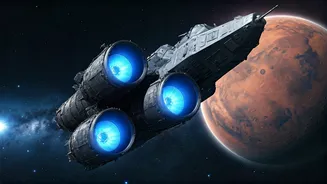
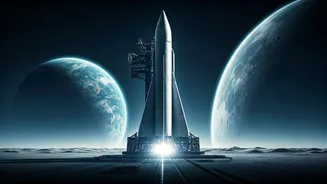
The SR-1, or Space Reactor-1 Freedom, represents NASA's tangible commitment to making nuclear propulsion a reality for deep space missions, with an ambitious launch target set for the end of 2028. This groundbreaking spacecraft is envisioned to dramatically alter the dynamics of interplanetary travel, making journeys to Mars significantly faster, more resource-efficient, and crucially, safer for human crews. Current projections suggest SR-1 will feature a distinctive, arrow-like design, with the uranium-powered nuclear reactor positioned at the forefront to generate power. The generated electricity will then drive the propulsion systems located at the rear. A critical component of the SR-1's design includes extensive radiator fins mounted on its sides. These radiators are essential for dissipating the immense heat generated by the reactor and other systems, preventing the spacecraft from overheating in the vacuum of space. Successful implementation of SR-1’s technology could unlock unprecedented capabilities for exploring the solar system and beyond.
The New Space Race
The accelerated timeline for SR-1's development—with hardware development commencing soon, assembly and testing slated for early 2028, and a launch by year's end—is a direct response to the intensifying global competition in space exploration. Traditional space projects often span many years, but the current geopolitical climate, marked by a renewed and pronounced 'space race' involving major players like the United States, China, and Russia, necessitates a faster pace. These nations are vigorously pursuing advancements in lunar base construction, deep-space missions, and critically, space-based nuclear technology. The nation that achieves a breakthrough in nuclear propulsion first will gain a substantial strategic advantage in establishing a dominant presence and undertaking ambitious exploratory endeavors. Consequently, mastering nuclear propulsion is viewed as one of the most significant technological leaps available on the current roadmap of space capabilities, driving NASA's urgent push to realize the SR-1 mission.