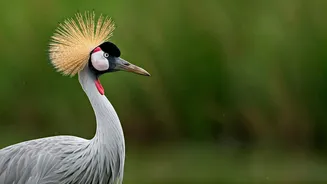








Distinct Physical Traits
While both cranes and storks boast long legs and necks, a closer look reveals key differences. Cranes tend to have a sleeker build, with their necks held
straight and upright, both when standing and in flight. They often exhibit a patch of bare red skin or a crown on their heads. Storks, on the other hand, appear more robust and heavier-boned. Their necks are often curved, especially at rest, and their bills are typically longer and sturdier, with fully feathered heads. Although both species stand tall, cranes generally possess a more elegant, upright posture, making them appear taller, while storks present a sturdier, more grounded presence.
Size and Wingspan Matters
When it comes to sheer size, cranes often have the edge. Their wingspans can range significantly, from 5.5 feet to an impressive 8 feet or more. Species like the Sarus crane are among the tallest flying birds. Storks generally have a wingspan between 5 and 7.5 feet, though some species, like the Marabou stork, can rival certain cranes in size. Cranes, due to their build and posture, often appear to have a greater height. While size does vary considerably between different species within both families, cranes are typically recognized for their impressive stature, often dominating the landscape with their height.
Behavioral Contrasts Unveiled
The social and communication behaviors of cranes and storks offer a clear distinction. Cranes are known for their elaborate and often lengthy courtship rituals, which include synchronized dancing, bowing, and tossing objects, as they form lifelong pair bonds. They are also quite vocal, frequently engaging in loud duets whose calls can travel great distances. Storks, in contrast, are generally much quieter. Their primary form of communication is bill-clattering, rather than vocalizations. While cranes often migrate in large flocks, storks are more solitary or move in smaller groups. Cranes seem to express a more flamboyant passion, whereas storks focus more intently on practical feeding strategies.
Flight and Dietary Habits
Observing their flight patterns and what they consume can further differentiate these birds. Cranes typically fly with steady wingbeats, often forming V-formations, and their necks remain extended straight ahead, accompanied by their characteristic trumpeting calls. Storks, however, tend to glide more, utilizing thermal currents for buoyant and seemingly effortless flight, usually in silence. Their diets also differ considerably. Cranes are more omnivorous, feeding on a mix of seeds, roots, insects, and small amphibians. Storks are predominantly carnivorous, actively hunting for fish, reptiles, and small mammals in shallow aquatic environments, and they are also known to scavenge.
Nesting Preferences and Protection
The locations and styles of their nests provide another reliable distinguishing feature. Cranes typically build their nests on the ground, often in wetlands, where they lay one to two eggs. Both parents diligently guard their nest and young. Storks, conversely, construct large, substantial nests high up, usually in trees, on cliffs, or even on rooftops. These nests are often reused and expanded over time, becoming quite massive. Storks typically lay between two and five eggs. While cranes tend to defend their nests with bold presence on the ground, storks opt for the safety of elevated, strategic locations for their brooding.