




A Historic Lunar Return
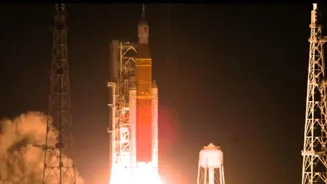
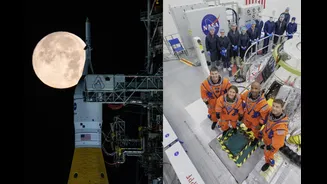
After a hiatus of over five decades since NASA's Apollo program concluded in 1972, humans are once again set to journey towards the Moon. The Artemis 2 mission,
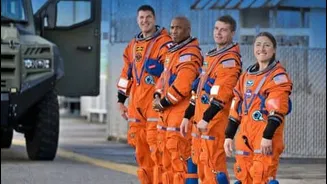
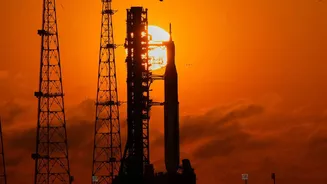
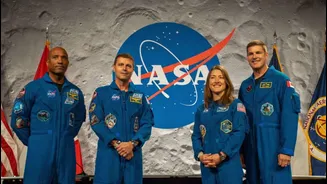
featuring a crew of four astronauts, is poised for launch, marking a significant revival of crewed lunar exploration. Despite earlier setbacks in February and March, NASA is preparing for an April 1st liftoff, with April 2nd being the corresponding date in India. The astronauts will not be making a landing; instead, their mission involves a circumlunar trajectory, a loop around the Moon. This journey is expected to shatter at least two significant spaceflight records. Depending on the precise launch timing and their chosen flight path, the Artemis 2 crew could reach an astonishing peak distance of over 400,000 kilometers from Earth, the farthest any humans have ventured since the Apollo 13 mission in 1970. Furthermore, upon their return, they are projected to achieve speeds of around 40,000 kilometers per hour, surpassing the existing record set by Apollo 10 at 39,897 kilometers per hour back in 1969. This 10-day test mission represents an incredible milestone in spaceflight and a renewed chapter in humanity's exploration of our closest celestial neighbor.
Water: The Game Changer
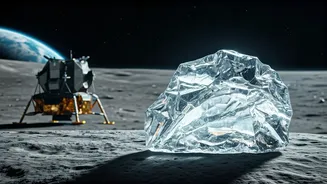
The rekindled interest in sending humans back to the Moon owes a significant debt to the groundbreaking discovery of water, largely facilitated by India's Chandrayaan-1 mission. Prior to this finding, NASA's Apollo program had concluded with the prevailing scientific consensus that the Moon was essentially a barren, geologically inactive, and uninhabitable world. Analysis of lunar rock samples brought back by Apollo astronauts led to the conclusion that water was absent. This absence presented a major hurdle for sustained human presence, as every necessity, from life support systems to rocket propulsion fuel, would have to be ferried from Earth, rendering missions prohibitively expensive and impractical. G Madhavan Nair, the former chairman of the Indian Space Research Organisation (Isro) who oversaw Chandrayaan-1, noted that after the initial landings, the prevailing view was that the Moon held little of interest. However, the discovery of water molecules, particularly in the form of hydroxyl and water ice concentrated in the permanently shadowed craters of the southern polar region, fundamentally altered this perspective. This finding suggested the possibility of in-situ resource utilization, where water could be extracted and potentially used for drinking, oxygen, and even rocket fuel production (by splitting it into hydrogen and oxygen), dramatically enhancing the feasibility and sustainability of future lunar endeavors.
Chandrayaan-1's Scientific Bounty
Chandrayaan-1, conceived as a sophisticated remote-sensing mission, was equipped with a suite of both Indian and international scientific instruments. Crucially, it carried NASA's Moon Mineralogy Mapper alongside Isro's own spectrometer. The mission's design wasn't predicated on the certainty of finding water, but rather on exploring existing theories and gathering data. S Somanath, former Isro chairman and overseer of Chandrayaan-3, explained that the inclusion of a NASA payload specifically designed to detect water signatures, coupled with Isro's spectrometer, was a deliberate choice. The data returned was subtle, requiring careful analysis. Spectral signatures indicated the presence of hydroxyl and water molecules embedded within lunar minerals across vast swathes of the Moon's surface, with higher concentrations observed towards the polar regions. The confirmation and subsequent publication of these findings by both NASA and Isro, as Somanath stated, solidified the reality of water on the Moon. Further analysis suggested that this water could exist as ice in regions that never see sunlight. The identification of hydroxyl molecules, particularly near the poles, made the prospect of finding trapped water or ice concrete. While the Moon's lack of atmosphere prevents liquid water from persisting on the surface, its presence in the regolith, buried away from direct solar radiation, presents a viable resource for future exploration and utilization. Beyond water, Chandrayaan-1 also identified significant deposits of helium, notably helium-3, an isotope frequently discussed as a potential fuel for future nuclear fusion reactors.
Shaping Future Lunar Vision
The impact of Chandrayaan-1 extends far beyond the initial water discovery, significantly reshaping the trajectory of lunar exploration. M Annadurai, the project director for Chandrayaan-1, asserts that the mission unequivocally revitalized interest in the Moon, with its findings consistently referenced in international scientific forums. The post-Chandrayaan vision has evolved from simple flybys and brief visits to ambitious plans for extended stays, enhanced international collaboration, the establishment of a lunar space station, and even missions venturing deeper into the solar system. Annadurai articulates this future, stating, "The Moon becomes an outpost, a launch pad to Mars." This paradigm shift is further exemplified by Isro's subsequent Chandrayaan-3 mission in 2023, which achieved a soft landing near the Moon's south pole. The Chandrayaan-3 craft provided invaluable direct, surface-level data concerning regolith behavior, thermal properties, and seismic activity. Somanath highlighted that this mission offered insights that earlier remote-sensing missions could only infer, collectively demonstrating that the Moon is not a geologically inert body, but rather a dynamic and evolving celestial object. The timing of Chandrayaan-1 also proved serendipitous, coinciding with advancements in low-cost robotic technologies that made lunar missions more accessible to a wider range of international space agencies and commercial entities, further accelerating the momentum towards a sustained human presence on the Moon.