



The Slippery Problem
Every home cook has experienced that heart-stopping moment when their cutting board slides precariously close to the counter's edge during food preparation.
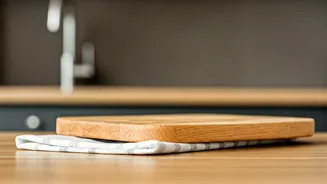
While we meticulously select sharp knives and the freshest ingredients, the instability of our workspace often goes unaddressed, posing a significant safety risk. This common kitchen hazard, leading to potential accidents and cross-contamination, can be surprisingly and inexpensively solved using a method as basic as a damp kitchen towel, proving that effective solutions aren't always costly.
Science of Stability
The effectiveness of a damp towel in stabilizing a cutting board lies in fundamental physics. The friction between a dry board, whether wood or plastic, and a smooth countertop is minimal, allowing for easy slippage. However, introducing a damp towel dramatically increases this friction. Water's ability to create surface tension between the towel and both the board and the counter surface acts as an anchor, effectively locking the board in place. This simple principle combats the inherent slipperiness, ensuring a steady platform for all your culinary tasks and preventing the board from sliding unexpectedly during chopping or dicing.
Board Types & Towel Power
This damp towel trick is universally beneficial, regardless of your cutting board material. For wooden boards, while aesthetically pleasing and naturally antibacterial, their porous nature can lead to water absorption and potential warping if left in excess moisture. A damp towel prevents the board from sitting in pooled water, safeguarding its integrity. Plastic boards, often favored for their dishwasher-safe convenience, tend to have smoother undersides, making them more prone to slipping. The damp towel adds crucial grip and a bit of weight, significantly improving their stability during vigorous use and making them a more secure option.
Hygiene and Preparation
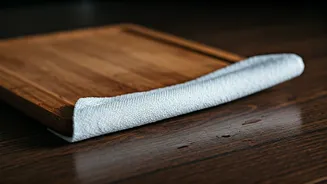
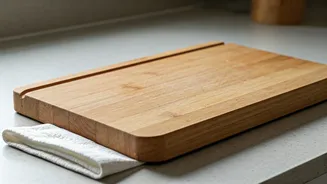
Beyond stability, a fixed cutting board is paramount for kitchen hygiene. Any movement can result in food debris falling onto unclean counter surfaces or accidental contact with other ingredients, increasing the risk of cross-contamination. A steady board allows for precise movements, crucial for maintaining cleanliness. To set up this simple yet effective system, lightly dampen a thin kitchen towel or a few layered paper towels in cold water, wring out excess moisture so it's just damp, not dripping. Spread it flat on the counter, place your cutting board on top, and apply gentle pressure to secure it. This quick setup takes mere seconds and offers a science-backed, cost-free way to enhance both safety and cleanliness in your kitchen.