





The Sahara's Allure
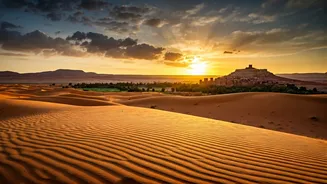
Southern Morocco beckons with its stark beauty, a land where vast, undulating dunes of the Sahara Desert meet ancient traditions. The journey from the High
Atlas Mountains is a dramatic transformation, unveiling a landscape dotted with ochre-colored kasbahs, verdant oases, and endless sandy expanses. A camel trek into the Sahara at sunset offers a profound silence, a world away from urban clamor. Nights under a canopy of stars, far from city lights, are truly unforgettable, enhanced by the warm hospitality of traditional Berber camps, complete with hearty meals and rhythmic music. Merzouga, situated at the edge of Erg Chebbi's towering dunes, serves as a primary gateway to this unique ecosystem. From here, one can arrange excursions to discover the desert's natural wonders, engage with nomadic families, and witness the breathtaking spectacle of a desert sunrise. The path to Merzouga itself is an adventure, winding through dramatic scenery, including the impressive Todra Gorge and the geologically fascinating Dades Valley, renowned for its unique rock formations and ancient kasbahs.
Fortified Villages & Berber Heart
Beyond the sandy horizons, Southern Morocco is adorned with ancient fortified villages, known as kasbahs. These impressive structures, typically constructed from rammed earth, served dual purposes as dwellings and defensive strongholds. The Ait Benhaddou, a UNESCO World Heritage site, stands as a premier example, a magnificent fortified village that has famously featured as a backdrop in numerous films. Other significant kasbahs, such as Taourirt and Tamadaght, also contribute to the region's rich architectural heritage. The cultural tapestry of Southern Morocco is deeply interwoven with Berber traditions. The Berber people, the original inhabitants of North Africa, possess a rich history, a distinct language, and unique customs. Engaging with these local communities, visiting their villages, and learning about their way of life provides a more profound appreciation of Southern Morocco's enduring spirit and cultural depth.
The Road Less Traveled
Navigating Southern Morocco can be accomplished through guided tours, self-drive options, or by hiring local drivers, though some roads present challenges. The optimal periods for visiting are spring (March to May) and autumn (September to November), offering more moderate temperatures conducive to exploration. The journey south often begins with an acclimation period in Marrakech, perhaps splitting stays between modern city accommodations and historic palace hotels. The planned itinerary might then embark on a circuit beyond Marrakech, potentially starting in the Agafay Desert, ascending into the Atlas Mountains, and descending along ancient oases towards the Algerian border. The return loop often traverses the Anti-Atlas Mountains, concluding near the Atlantic coast amidst wild argan groves. This comprehensive journey aims to encompass Berber history in the High Atlas, the historical impact of Arab traders, and the realities of modern nomadic life in the desert. A particularly evocative part of this southern exploration is the 'Memory Road,' a curated journey through remote landscapes, designed to offer a sense of profound connection to the land and its history.
Desert Luxury and Mountain Retreats
The Agafay Desert, a rocky expanse, offers an illusion of remoteness despite its proximity to Marrakech. Camps here provide safari-style tents with modern comforts, set against starkly beautiful desert vistas. Experiencing a desert storm, complete with flash floods in dry ravines, highlights the raw power of nature. Further south, nestled in the Atlas foothills, Berber Lodge offers an elegant retreat blending traditional materials with contemporary amenities, evoking the soul of a Berber home. Richard Branson's Kasbah Tamadot, a mountain resort, exemplifies luxury accommodation in the Atlas Mountains, having undergone renovations after a 2023 earthquake. The resort emphasizes its staff, largely recruited from nearby villages, and traditions like the daily tea ceremony, highlighting the personal touch and connection to the local community. These establishments offer more than just lodging; they are immersive experiences that connect guests with the unique environment and cultural ethos of Southern Morocco.
Valleys, Oases, and Ancient Sites
The drive from the Amazigh highlands often leads to the Skoura Valley, an oasis settlement historically significant for caravan routes. Descending from the Tizi n’Tichka pass, the journey reveals villages clinging to cliff walls and troglodyte dwellings. The iconic Aït-Ben-Haddou, a UNESCO World Heritage ksar, showcases remarkable mud-brick architecture and has served as a filming location for numerous epics. Guides here, often descendants of the founding clans, share insights into the ongoing preservation efforts and the daily lives of its remaining residents. Heading towards the desert, the 'Memory Road' traverses arid expanses and highlights the impact of flash floods on infrastructure. Tizkmoudine, an ancient oasis town, now offers a glimpse into its past, with some buildings repurposed for tourist stays. The journey emphasizes the vital role of water, tracing its path from mountain springs and illustrating its significance as the 'source of life' for desert communities. This segment of the journey reveals the resilience and adaptation of life in seemingly harsh environments.
Saharan Encounters and Nomadic Life
The journey progresses into the Sahara, where the nomadic lifestyle, contrary to a pure sand ocean image, is pastoral, centered around herding livestock that require pasture. Nomads possess intimate knowledge of the desert, including how to find water and even hunt for meteorites, which can be highly valuable. Encounters with nomads often involve shared traditions, such as the ceremonial wrapping of the head in indigo-dyed scarves and the lively sharing of stories and music. Camps in the Sahara offer an authentic experience, where the vastness of the desert can be appreciated under a sky filled with stars. Learning about the challenges faced by nomads, such as increasingly erratic rainfall impacting traditional migratory patterns, offers a deeper understanding of their connection to the land and their resilience. Even in the desert, moments of unexpected culture emerge, like a showing of the classic film 'Casablanca' in an oasis setting, blending cinematic nostalgia with the present reality of desert life.
Coastal Breezes and Lingering Reflections
The final leg of the journey often leads towards the coast, a transition from the arid interior to the refreshing Atlantic breezes. Guesthouses situated amidst wild argan trees offer panoramic views, with the distant sights and sounds of coastal cities like Agadir providing a contrast to the deep desert tranquility. This part of the trip encourages reflection on the experiences encountered, from the grandeur of the Sahara to the rich cultural heritage of the Berber people and the architectural marvels of ancient kasbahs. The journey emphasizes that even when a destination appears fully explored, there are always more layers to discover, more paths to follow, and deeper connections to be made, mirroring the ongoing quest for knowledge and understanding, much like traversing an unknown trail leading to unseen valleys.