




The Patteda Anchu
Originating from North Karnataka and with a history stretching back to the 10th century, the Patteda Anchu is a remarkable example of ancient sustainable
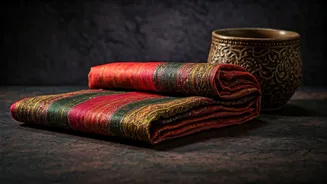
fashion. This robust cotton saree is characterized by its striking mustard or red border set against a checked body, offering the unique advantage of being entirely reversible. It requires no additional fall or lining, and crucially, no ironing, making it exceptionally low-maintenance. Its popularity waned with the influx of cheaper synthetic fabrics in rural markets, but as a zero-maintenance, eco-friendly garment, it remains unparalleled. Its enduring design and practicality highlight a forgotten era of intelligent textile design.
Himroo's Mughal Roots
Hailing from Aurangabad and boasting origins in the opulent Mughal era, Himroo is an ingenious fusion of silk and cotton. The name itself, derived from the Persian word 'Hum-ruh' meaning 'similar,' hints at its resemblance to pure silk. This fabric offers the luxurious appearance of heavy brocade while remaining remarkably breathable, an essential quality for enduring India's often harsh heat. Unfortunately, the market is now saturated with inferior power-loom imitations that are falsely marketed as authentic Himroo, obscuring the brilliance of the original craft.
Mashru's Ingenious Weave
In Patan, Gujarat, weavers developed a unique fabric known as Mashru, an Arabic term signifying 'permitted.' This innovation arose from religious proscriptions that prevented Muslim men from wearing pure silk directly against their skin. The solution was a cleverly engineered weave, featuring luxurious silk on the exterior while maintaining a soft cotton interior. This construction provides an ultimate 'comfort-luxury' experience, although finding genuine handwoven Mashru today is an increasingly rare endeavor due to the prevalence of mass-produced alternatives.
Siddipet's Storytelling Drape
The Siddipet Gollabhama saree is a true narrative woven into fabric, adorned with exquisite motifs depicting a 'Gollabhama,' a milkmaid carrying a pot. What sets this saree apart is that these intricate designs are not embroidered post-weaving; rather, they are meticulously incorporated into the fabric itself through a complex extra-weft technique by the weavers. This process is extraordinarily labor-intensive, leading many younger artisans to abandon the craft as they are often inadequately compensated for such painstaking and slow traditional work.
The Tribal Kunbi
While Goa is often associated with beaches, its textile heritage includes the striking Kunbi saree. Traditionally worn by tribal communities, this beautiful red-and-black checkered drape was crafted on backstrap looms. Women would wear these sarees short, often without a blouse or petticoat, allowing for ease of movement while working in paddy fields. The advent of Portuguese colonial dress codes and the rise of modern power looms nearly led to the disappearance of this weave. Today, only a small number of weavers possess the knowledge, yet its breathable, minimalist pattern holds immense potential for contemporary fashion.
Madurai's Sungudi
In Madurai, Saurashtrian weavers developed the Sungudi saree, a testament to traditional cotton craftsmanship. The creation of an authentic Sungudi involves the laborious process of tying thousands of tiny knots by hand before immersing the fine cotton fabric in natural dyes. This results in an exceptionally breathable textile, perfect for the sweltering summers of Southern India. Unfortunately, the market is now dominated by screen-printed imitations, making genuine Sungudi increasingly difficult to find.
Maharashtra's Karvath Kati
Amidst the widespread admiration for Maharashtra's Paithani sarees, the weavers of the Vidarbha region face struggles with their own unique creation: the Karvath Kati. Woven from pure, wild Tussar silk, this saree derives its name from its distinctive geometric borders that resemble saw teeth. It possesses a brilliant, earthy elegance that distinguishes itself from the heavily embellished silks often seen at celebrations, representing a subtle yet powerful form of textile artistry.