







Orbital Data Centers Emerge
Cowboy Space, formerly Aetherflux, has secured a substantial $275 million in Series B funding, propelling its valuation to $2 billion. This funding fuels
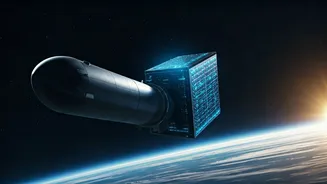
the company's innovative vision to construct rockets whose upper stages will function as data centers once deployed in low Earth orbit. The startup, founded less than two years ago, aims to tackle the escalating demand for computational power and energy that terrestrial infrastructure struggles to meet. This significant investment, led by early-stage investor Index Ventures, highlights the burgeoning interest in space-based solutions for advanced computing needs. The company has now amassed approximately $365 million in total funding to date, underscoring investor confidence in its groundbreaking approach to satellite technology and data processing capabilities within the orbital environment.
A Hybrid Rocket-Satellite Approach
Instead of relying on separate launch vehicles like some competitors, Cowboy Space is adopting a vertically integrated strategy. The company is designing its rocket's upper stage and the data center payload as a unified system. This integrated approach is intended to minimize redundant mass, thereby maximizing the efficiency and capacity of both power generation and computational resources delivered to orbit. This means the rocket itself, post-launch, transforms into a functional data center. The design philosophy emphasizes optimizing the entire vehicle for AI infrastructure, with the stage structure potentially serving as a radiator for cooling the data center components. This hybrid model, a departure from conventional rocket design, allows for a more streamlined and powerful orbital presence. Cowboy is developing its launch vehicle, upper stage, and orbital compute platform as a single, optimized system, ensuring full control over the core architecture without reliance on external providers.
Demonstrating Power and Compute
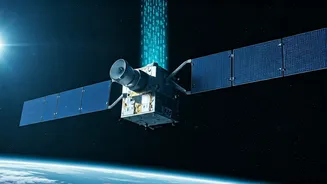
Cowboy Space's initial foray into space is slated for later this year with a small satellite mission. Developed in collaboration with Apex, this mission will serve as a crucial technology demonstrator, focusing on wirelessly beaming power from low Earth orbit to the ground using infrared lasers. While this represents a scaled-down validation of the physics and methodology, the long-term business objective extends beyond just power transmission to Earth. The primary focus is on utilizing that orbital power for AI computations. Looking ahead to early next year, Cowboy plans to deploy its first 'Galactic Brain' data center node, equipped with NVIDIA's Vera Rubin modules designed for AI tasks in space. This mission will be a significant step in showcasing AI compute powered by solar energy, with a more ambitious goal of launching its first proprietary rocket carrying a one-megawatt data center by the end of 2028.
Market Potential and Future Growth
The emergence of orbital data centers is tapping into a rapidly expanding market, driven by the insatiable demand for AI compute and energy. Companies like Anthropic have already expressed interest in leveraging orbital data centers, highlighting the critical need for solutions that surpass terrestrial limitations. While Cowboy Space has yet to launch its first satellite, the substantial funding it has secured underscores significant investor appetite for this burgeoning sector. This trend is gaining momentum, with other companies also exploring innovative ways to supply power in space. As Cowboy Space focuses on demonstrating its capabilities before scaling to full commercial services, its success could pave the way for a new era of space-based computing and energy solutions. The company is prioritizing mass efficiency and performance in its design, focusing on delivering maximum compute and power to orbit rather than solely on reusability, though reusability will be incorporated where economically viable.