





The Quest for Mars
The dream of sending humans to Mars, while seemingly distant with current rocket technology and its inherent limitations, is inching closer thanks to innovative
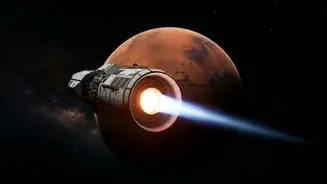
propulsion systems. Traditional chemical rockets, while powerful, are incredibly fuel-intensive and inefficient for the vast distances of deep space. They burn through propellant rapidly, making spacecraft heavy and less maneuverable over long journeys. NASA, recognizing these drawbacks, has been diligently exploring alternative propulsion methods, with a significant breakthrough recently emerging from its Jet Propulsion Laboratory (JPL). This advancement in electric thruster technology holds immense promise, potentially providing the key to achieving human missions to the Red Planet. The journey to Mars demands a propulsion system that can sustain acceleration over extended periods without requiring massive fuel loads. This is precisely where the focus on electric propulsion, and specifically NASA's latest development, becomes critical for future interplanetary endeavors.
Electric Propulsion Explained
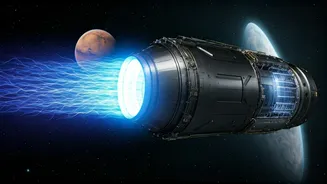
At its core, propulsion relies on a fundamental physics principle: accelerating a mass in one direction results in an equal and opposite reaction, propelling an object forward. While chemical rockets achieve this through combustion, electric thrusters utilize electrical energy to achieve the same outcome. This electrical power, sourced from either solar arrays or potentially nuclear reactors, is used to ionize inert gases like xenon or krypton. Once ionized, these gas particles become charged and are then manipulated by electromagnetic fields. These fields accelerate the charged particles, expelling them from the thruster at high velocities. This expulsion creates thrust, pushing the spacecraft in the opposite direction. Although individual electric thrusters typically generate less than one pound of thrust, the efficiency and continuous operation in the vacuum of space allow this force to accumulate over vast distances, enabling spacecraft to reach remarkable speeds. Crucially, electric thrusters are vastly more fuel-efficient, using up to 90% less propellant than chemical rockets, which significantly reduces the overall mass of a spacecraft.
The MPD Thruster Advantage
While existing electric thrusters are efficient, their low thrust output means that reaching distant destinations like Mars takes an exceptionally long time. For instance, NASA's Psyche spacecraft, launched in 2023 with a similar electric thruster, is currently traveling at about 12,333 mph, a speed that will eventually lead to 124,000 mph but over many years. This slow acceleration is suitable for smaller, uncrewed probes but presents a significant challenge for carrying astronauts and their essential life support and equipment. NASA's Jet Propulsion Laboratory has been developing Magnetoplasmadynamic (MPD) thrusters since the 1960s, and their latest iteration represents a substantial leap forward. This new MPD thruster operates at significantly higher power levels, up to 120 kW, which is an astonishing 25 times more powerful than the thrusters on the Psyche mission. The key innovation lies in its operation at much higher currents and its use of lithium plasma as a propellant, energized by nuclear power. This increased power output is crucial for accelerating larger spacecraft and reducing transit times for human missions.
Scaling Up for Mars
The potential of NASA's new Lithium-Plasma MPD thruster is immense, but significant engineering challenges remain before it can power a human mission to Mars. The current 120 kW power output is impressive, but reaching the Red Planet with a crew would require considerably more. NASA's goal is to scale these thrusters up to between 500 kW and one megawatt each. Even at one megawatt per thruster, a mission to Mars would likely necessitate multiple units, potentially requiring two to four megawatts of total power. Beyond sheer power, managing the extreme heat generated during operation is a critical hurdle. The central tungsten electrode can reach temperatures of up to 5,000 degrees Fahrenheit during ignition. Ensuring the thrusters can operate reliably for the estimated 23,000-hour journey to Mars demands robust thermal management and exceptional durability. Despite these formidable obstacles, NASA remains optimistic, viewing the successful test of this high-power thruster as a vital step and a promising foundation for tackling the complexities of scaling up for future deep space endeavors.