

A Cosmic Target
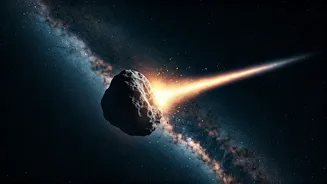
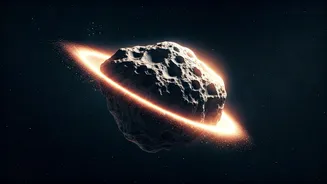
The Didymos–Dimorphos asteroid system served as the perfect proving ground for NASA's audacious planetary defense experiment. Didymos, a substantial celestial
body approximately 850 meters in diameter, hosts a smaller companion, Dimorphos, which measures about 170 meters across and orbits its larger partner. Scientists had meticulously charted Dimorphos' orbital period and distance from Didymos beforehand, establishing a precise baseline. This allowed for clear measurement of any orbital changes following the DART impact. Crucially, because Dimorphos is gravitationally tethered to Didymos, there was no risk of the collision inadvertently sending the smaller asteroid on a trajectory towards Earth, ensuring the test was confined to a safe, controlled environment within the solar system.
The Impact's Ripple Effect
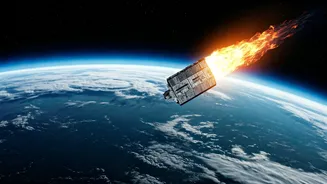
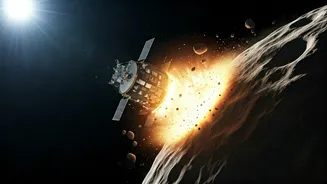
On September 26, 2022, the DART spacecraft executed its mission with incredible force, colliding with Dimorphos at a velocity of 6.6 kilometers per second. This monumental impact successfully shortened Dimorphos' orbit around Didymos from 11 hours and 55 minutes to 11 hours and 23 minutes. The mission's goal was a modest reduction of at least 73 seconds, meaning the actual outcome far surpassed expectations, marking a resounding success. Furthermore, new analyses led by researchers like Makadia and Chesley from NASA's Jet Propulsion Laboratory revealed a significant contributing factor: the cloud of debris, known as ejecta, ejected during the crater formation. This ejected material, propelled away from Dimorphos, carried momentum with it, and due to the fundamental principle of conservation of momentum, it imparted an additional push onto Dimorphos.
Momentum's Double Boost
Scientists have quantified this additional push as a 'momentum enhancement factor,' which for the DART impact on Dimorphos, registered a value of two. This means the force that altered Dimorphos' orbit was effectively doubled by the momentum carried away by the ejected debris. The implications are profound: this extra impulse provided a significant thrust that propelled Dimorphos. Because Dimorphos and Didymos are gravitationally bound, this enhanced push not only affected Dimorphos but also subtly tugged the entire binary system, altering their combined orbit around the sun. This change, though small, measured at 0.15 seconds in their orbital period, demonstrates the potential of such techniques to deflect hazardous asteroids if detected with sufficient advance warning.
Observational Dedication
Precisely determining the subtle orbital shift of the Didymos–Dimorphos system around the sun was a remarkable feat, greatly aided by the dedicated efforts of 49 amateur astronomers. These volunteers played a crucial role by observing stellar occultations, events where the asteroid system passes in front of a star from Earth's perspective. Such observations, though challenging to capture due to their narrow visibility paths on Earth and weather dependency, provide invaluable data on an asteroid's shape, size, position, and trajectory. Between October 2022 and March 2025, these dedicated observers undertook journeys to remote locations to witness 22 such occultations. This sustained observational campaign provided the critical data, alongside years of existing ground-based observations, that enabled Makadia and Chesley's team to accurately calculate the change in the binary system's solar orbit, underscoring the power of citizen science in advancing scientific understanding.
Asteroid Insights
Beyond confirming the orbital change, the data meticulously gathered from the DART impact and subsequent observations allowed scientists to infer the densities of both asteroids. Didymos exhibits a density of 2,600 kilograms per cubic meter. Dimorphos, however, revealed itself to be less dense than previously estimated, with a density of 1,540 kg per cubic meter. This lower density suggests that Dimorphos is a relatively loosely consolidated collection of material, often referred to as a 'rubble pile.' This finding strongly supports the hypothesis that Dimorphos likely originated from material that was once ejected from Didymos, creating a fascinating binary system with a shared, yet distinct, history. These detailed insights were compiled and published in a scientific journal on March 6.