






A Fruitful Beginning
The tradition of observing Pi Day, honoring the mathematical constant π (approximately 3.14), didn't originate from a classroom or a textbook. Instead,
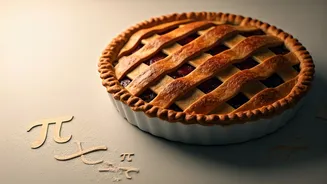
it was first brought to life in 1988 by physicist Larry Shaw at the renowned Exploratorium. His initial celebration was a whimsical affair, featuring a spirited parade that circled a designated round area within the museum. The festivities were further enhanced by the delightful consumption of actual fruit pies, making the inaugural Pi Day a memorable and tasty event. This playful inception set the stage for a global appreciation of mathematics.
Coincidental Cosmic Alignment
Beyond its mathematical significance, March 14th holds another profound connection for science enthusiasts. It marks the birthday of one of history's most brilliant minds, Albert Einstein. The renowned theoretical physicist, best known for his theory of relativity, was born on this very day. This dual celebration imbues Pi Day with an extra layer of significance, resonating deeply with those who admire scientific achievement and the wonders of the universe. It's a day when both mathematical constants and scientific geniuses are honored.
Official Recognition
The appreciation for Pi Day eventually transcended informal gatherings and casual observance. In 2009, a significant step was taken when the United States House of Representatives officially recognized Pi Day. This endorsement was not merely symbolic; it was enacted with the specific intention of fostering a greater interest in the fields of mathematics and science among the public. By establishing an official holiday, the aim was to encourage broader engagement with these crucial subjects.
An Infinite Journey
The very essence of Pi is its unending nature. As an irrational number, its decimal representation continues infinitely without ever entering a repeating pattern. This remarkable characteristic means that no matter how advanced our computational tools become, we will never reach the end of Pi's digits. Scientists and mathematicians have tirelessly worked, utilizing powerful computers to calculate trillions of digits of Pi, yet the quest for its final digit remains an endless pursuit, underscoring its profound mystery.
An Approximation's Day
While March 14th is the primary Pi Day, there exists another date dedicated to a closely related concept: Pi Approximation Day. Observed on July 22nd, this day celebrates the fraction 22/7, which serves as a widely used and remarkably accurate approximation of Pi. The choice of date is deliberate, as it directly reflects the fractional form that closely mirrors the value of Pi, offering a different yet equally valid way to acknowledge this fundamental mathematical constant.
The Precise Pi Moment
For those who appreciate the finer details, Pi Day offers an even more precise moment of commemoration. The exact time that perfectly mirrors the beginning of Pi's digits is 1:59 PM on March 14th. When combined with the date, March 14 (written as 3/14), this specific time creates the sequence 3.14159, which represents the first six digits of Pi. This meticulously chosen minute provides a unique opportunity for enthusiasts to celebrate the constant in its most granular form.