




Navigating the Void
Launching anything into space is a colossal engineering feat, demanding precise control over thrust and fuel to overcome Earth's immense gravitational
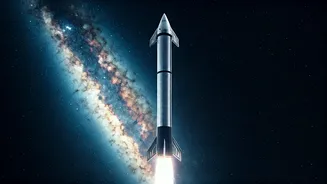
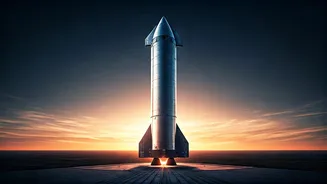
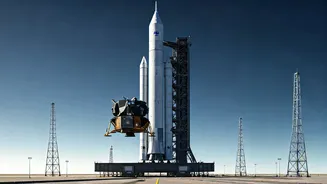
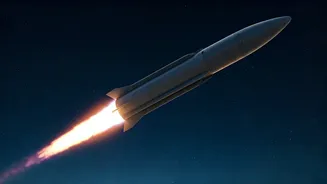
pull. Rockets don't just blast off vertically; they embark on carefully calculated curved trajectories, leveraging gravity itself to achieve orbital velocity. Beyond the initial ascent, maintaining the correct course requires sophisticated maneuvering. One such vital technique is the 'roll program,' a controlled rotation that plays a surprisingly significant role in guiding these colossal machines through the atmosphere and beyond. This method is a testament to the ingenuity of aerospace engineers who devised ways to simplify complex adjustments in a challenging environment. Understanding this rolling motion is key to appreciating the precision involved in space missions.
Understanding Rocket Rotation
Much like airplanes use roll, yaw, and pitch to steer, rockets also operate on these fundamental rotational principles, even though their physical designs differ greatly. For an aircraft, a roll is typically induced by uneven lift across its wings, causing it to tilt side-to-side. Pitch, controlled by the horizontal tail rudder, manages the aircraft's elevation, allowing it to ascend or descend. Yaw, managed by the vertical rudder, dictates horizontal turns. While rockets lack wings and rudders, their internal systems still dictate roll, pitch, and yaw, which in turn define their trajectory. The 'roll program' specifically addresses the roll axis, integrating it into the overall navigation strategy to simplify subsequent maneuvers and enhance efficiency. This adaptation is crucial for maintaining precise control in the absence of conventional aerodynamic surfaces.
The Art of the Roll
Rockets undertake a slow, deliberate roll during flight primarily because this action effectively neutralizes the 'roll' element from the navigational equation. Once the rocket is stabilized in its roll, any required adjustments to its horizontal angle relative to a fixed point, like north (known as the azimuth), can be managed solely through adjustments in its pitch. This simplification is incredibly beneficial, as it means fewer complex control inputs are needed. Furthermore, by minimizing the need for constant mid-flight course corrections that would involve multiple axes, the roll program significantly conserves precious fuel. This efficiency is paramount for long-duration missions or when payload capacity is limited, making the roll program an indispensable tool for cost-effective space exploration.
Generating the Spin
Since rockets don't possess wings or rudders, the initiation and control of their roll maneuver rely on distinct engineering solutions. One primary method involves the use of auxiliary thrusters strategically positioned on the rocket's exterior. These small engines are oriented at angles that are not parallel to the main thrust, and sometimes they even fire in opposing directions. The cumulative effect of these thrust vectors creates an unbalanced force, inducing a rotational motion or roll. In more advanced rocket designs, gimbaled engines are employed. Gimbals are specialized pivot mechanisms that allow attached components, in this case, rocket engines, to swivel and rotate. By articulating these engines, engineers can direct their thrust in a way that generates the desired roll, offering precise control over the rotational speed and direction.
Fins and Gimbaled Control
Another ingenious method for achieving and managing a rocket's roll involves specialized fins located at the rear of the vehicle. These fins are designed with hinges, allowing them to deflect against the natural airflow as the rocket ascends. This deflection generates a force perpendicular to the rocket's direction of travel, creating lift that, in turn, causes the rocket to roll. To maximize this passive rolling effect, all these specialized fins are typically angled in the same direction. While modern stabilization technologies have somewhat reduced the reliance on these aerodynamic surfaces, they were absolutely fundamental to the success of early rocket designs. Alongside auxiliary thrusters and gimbaled engines, these hinged fins represent critical components in achieving the precise rotational control necessary for successful spaceflight.