
Peering Through Cosmic Veils
For the first time, astronomers are witnessing the birth of stars in the W51 region with an extraordinary level of detail, thanks to the James Webb Space
Telescope (JWST). While W51 has been observed before, JWST's unique capabilities allow it to penetrate the dense clouds of gas and dust that typically shroud these nascent stellar bodies. These cosmic veils, which block visible light, are transparent to the infrared radiation that JWST expertly captures. This breakthrough means that young stars, previously hidden from view, are now observable, providing a groundbreaking window into their earliest evolutionary stages. Researchers can now study these stellar infants as they are forming, a feat impossible with earlier optical and ground-based infrared telescopes that were hindered by the obscuring dust. The ability to see through these barriers marks a significant advancement in our understanding of star formation.
Unraveling Massive Star Formation
Beyond their sheer beauty, the latest images from JWST are profoundly significant for understanding how massive stars come into being. The formation process of high-mass stars, unlike their smaller counterparts, remains a complex puzzle for astrophysicists. The W51 region, a known hub for such star formation, provides a prime laboratory for JWST to investigate these mechanisms. By observing these hidden, young massive stars directly, scientists like Adam Ginsburg and Taehwa Yoo from the University of Florida can now scrutinize their birth environments and the physical processes at play. This direct observation allows for a deeper analysis of the accretion disks, outflows, and surrounding gas structures that contribute to the growth of these colossal stars, offering critical data to refine existing theories of stellar evolution.
Revealing Unseen Cosmic Structures
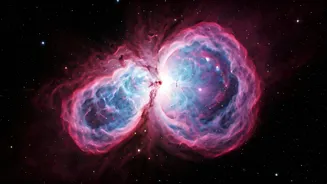
The remarkable resolution and sensitivity of the JWST have enabled the discovery of previously undetected features within the W51 star-forming complex. These newly revealed structures paint a vivid picture of the dynamic environment where stars are born. The images showcase intricate shockwaves propagating outward from newly formed stars, colossal bubbles of gas sculpted by stellar winds, and dense, dark filaments of dust that trace the flow of material. These complex formations offer tangible evidence of the powerful forces at work during stellar genesis. As researchers continue to pore over these images, they are consistently uncovering new and unexpected details, underscoring the transformative power of JWST's observations in advancing our knowledge of cosmic creation and the intricate choreography of star birth.