





The Asteroid Relocation Vision
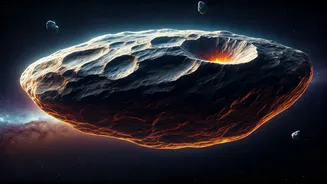
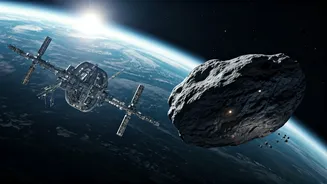
A forward-thinking company is currently investigating the practicalities of relocating a substantial asteroid, weighing approximately 100 metric tons,
to a secure orbit near Earth. This initiative, supported by both financial backers and potential clients, aims to transform a celestial body into a dynamic robotic research and development hub for in-space manufacturing and materials processing. The founder and CEO envisions bringing this asteroid into the Earth-moon system to establish a unique outpost. This ambitious undertaking involves collaborating with esteemed institutions like the University of Central Florida, Purdue University, the California Institute of Technology, and NASA's Jet Propulsion Laboratory. Together, they will meticulously identify suitable asteroids, analyze their orbital paths, and select the appropriate spacecraft technology to execute this mission, designated 'New Moon'.
Resource Potential of Asteroids
Near-Earth asteroids are treasure troves of valuable materials, presenting immense opportunities for space exploration and utilization. Some asteroids are rich in metals essential for constructing spacecraft and infrastructure in orbit, while others contain water, a critical resource that can be electrolyzed to produce rocket propellant. Beyond these direct uses, all asteroids possess inert materials that serve as excellent shielding against the harsh radiation environment of space, protecting both robotic probes and human crews. Recognizing this potential, experts highlight asteroids as the most readily accessible material source within our solar system. The ability to effectively harness these resources could fundamentally reshape how we conduct operations in space, making missions more sustainable and less reliant on costly launches from Earth.
Enabling Space Industrialization
The capacity to leverage resources already present in space represents a significant leap forward for a sustainable space economy. By utilizing in-situ resources such as water for fuel, metals for construction, and minerals for everything from radiation shielding to solar panel components, the dependency on launching all necessary materials from Earth's considerable gravity well is substantially reduced. This paradigm shift is crucial for long-term space endeavors. Advances in sky-survey technology, including the forthcoming Vera C. Rubin Observatory in Chile, are expected to significantly increase the discovery rate of smaller near-Earth asteroids, with an estimated 260 asteroids measuring 20 meters or less anticipated to be identified in the coming years. Furthermore, the company has established tracking facilities in multiple locations for monitoring satellites and asteroids, bolstering its capabilities in space situational awareness.
Technological Foundations
For over a decade, the company has been at the forefront of developing technologies specifically for asteroid resource utilization. This extensive experience includes significant work under contracts with major government agencies, accumulating a wealth of knowledge and expertise. The company and its collaborators hold a substantial portfolio of 23 patents that cover the four critical technological domains necessary for successful asteroid mining: detection, capture, movement, and the processing of space-based resources. A recent achievement involved the successful production and flight qualification of a 10-meter inflatable asteroid capture bag, funded by grants and matching private investment. A smaller, one-meter version of this capture bag was successfully deployed and retrieved within the microgravity vacuum environment of the International Space Station's Bishop Airlock, marking a pivotal de-risking milestone and the inaugural in-space demonstration of their core inflatable capture technology, paving the way for future applications in orbital debris remediation and asteroid capture.