


Hydrangeas: Bold Blooms
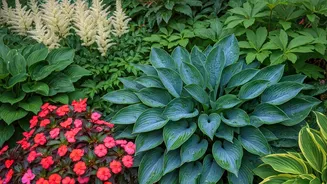
Hydrangeas and hostas are a classic garden duo, flourishing in similar environments like partial shade and rich, well-drained soil. Their compatibility
extends beyond shared growing needs; planting hostas at the base of larger hydrangeas offers a neat way to disguise their often bare lower stems. For a striking visual effect, master gardener Lorraine Ballato suggests pairing blue-leaved hostas with bigleaf or mountain hydrangeas to achieve a sophisticated, monochromatic color scheme that captivates the eye throughout the growing season. Hydrangeas, botanically known as Hydrangea spp., are adaptable across USDA Hardiness Zones 5-9. They can tolerate both partial and full sun, and their mature size varies significantly from 2 to 20 feet in height and 2 to 6 feet in width, offering a range of options for garden design.
Ferns: Lush Foliage
Ferns are a natural fit for any garden featuring hostas, thanks to their shared preference for shady spots and moist, rich soil. Their presence enhances the woodland feel hostas often evoke. While there are countless fern varieties, fiddlehead ferns are a hardy and widely available choice that pairs exceptionally well. Don't shy away from combining multiple foliage plants; the diverse shapes, sizes, and colors of hostas, coupled with the intricate textures of ferns, create a visually engaging display even without flowers. Many ferns, like the ostrich fern (Matteuccia struthiopteris), thrive in USDA Hardiness Zones 2-7 and can adapt to shade, partial, or even full sun conditions. They typically reach mature heights of 3-4 feet with a spread of about 1 foot, providing elegant vertical and textural elements.
Bleeding Hearts: Delicate Charm
Recognized as woodland shade-lovers, bleeding hearts (Lamprocapnos spectabilis) are an ideal companion for hostas. The exquisite, heart-shaped blooms of bleeding hearts provide a charming contrast to the robust foliage of hostas, while the hostas, in turn, can make the bleeding hearts appear even more lush and full. As the bleeding hearts naturally fade in mid-summer, the ever-growing hosta leaves effectively camouflage their spent foliage. This plant is resilient in USDA Hardiness Zones 3-9 and prefers shade to partial shade. Growing to a mature height of 1-3 feet with a spread of 2-3 feet, they bring a touch of delicate beauty to shaded garden corners.
Tulips: Spring Color Burst
For a garden that offers visual appeal throughout the year, spring bulbs like tulips (Tulipa spp.) are excellent companions for hostas, though they prefer partial to full sun rather than deep shade. Tulips provide a vibrant splash of color in early spring, filling in spaces as hostas begin to emerge. By the time the tulips finish blooming and their foliage begins to die back in late spring, the hosta's new leaves will have unfurled, neatly concealing the fading tulip leaves. Tulips are generally hardy in USDA Hardiness Zones 3-8, reaching mature heights of 9-24 inches with a spread of 6-9 inches, and they thrive in full sun conditions.
Alliums: Architectural Blooms
Alliums are celebrated for their dramatic, globe-shaped flower heads, but their foliage can be somewhat unassuming and sparse. This is precisely why they pair so wonderfully with hostas. By planting alliums behind hostas, you gain a striking pop of color and vertical interest, while the hosta's dense foliage effectively conceals the allium's less attractive leaves. Allium (Allium spp.) are adaptable to USDA Hardiness Zones 4-10 and perform best in partial to full sun. Their mature sizes can range from 1 to 4 feet in height with a spread of 3-10 inches, adding a unique architectural element to the garden backdrop.
Daffodils: Early Brightness
Similar to tulips, daffodils (Narcissus spp.) are early spring bulbs that create a beautiful partnership with hostas, offering staggered bloom times for prolonged garden interest. When planted together, this combination ensures a dynamic and vibrant display across different seasons. To maximize their bloom longevity, it's advisable to avoid planting daffodils in overly shaded areas, opting instead for partial or full sun. Daffodils are hardy in USDA Hardiness Zones 4-8, with mature heights ranging from 6 to 30 inches and a spread of 6 to 12 inches, providing cheerful color as the garden awakens in spring.
Coral Bells: Textured Foliage
Coral bells, scientifically known as Heuchera spp., are a diverse group of shade-loving perennials renowned for their stunning foliage. The delicate, often ruffled leaves, available in a spectrum of vibrant colors, provide a captivating contrast against the broad, typically green leaves of hostas. As described by botanical stylist and gardener Laura Janney, this variety of colors offers year-round visual interest in the shade garden. Coral bells are well-suited for USDA Hardiness Zones 4-9 and thrive in partial to full sun. They typically reach mature heights of 8-19 inches with a substantial spread of 12-24 inches, adding a rich tapestry of color and texture.
Astilbe: Feathery Blooms
Astilbe (Astilbe spp.) stands out as another excellent choice for shaded garden areas, creating a gorgeous visual harmony when planted alongside hostas. Its distinctive fern-like foliage and plume-like flowers add a layer of exquisite texture that beautifully complements the hosta's smooth, mounding form. Even after their blooms have faded, Astilbe flowers retain their shape, offering continued vertical interest that enhances the hosta display. Resilient in USDA Hardiness Zones 3-8, Astilbe prefers partial to full sun exposure. They range in mature size from 6 to 24 inches in height and 6 to 60 inches in width, providing both delicate blooms and structural form.
Siberian Bugloss: Groundcover Elegance
Brunnera macrophylla, commonly known as Siberian bugloss, is a genus of flowering perennials particularly suited to shady environments. Similar to lungwort, Siberian bugloss functions as a low-growing groundcover, offering refined foliage and delicate blue flowers in the spring. It looks particularly attractive when planted at the base of shrubs and trees, creating a verdant carpet that allows hostas to provide a lush, leafy backdrop. This plant thrives in USDA Hardiness Zones 3-8, adapting to shade, partial, or full sun. Its mature size typically ranges from 12-18 inches in height and 18-30 inches in width, providing a delicate yet substantial ground layer.
Grape Hyacinth: Spring Accents
Dainty and charming, grape hyacinths (Muscari armeniacum) are a delightful addition when planted near hostas and other spring-blooming favorites like daffodils and tulips. Like many spring bulbs, grape hyacinths perform best in conditions ranging from full sun to part shade, and they require rich, well-drained soil, making them an ideal companion for hostas which share these preferences. They typically reach a mature height of 6-9 inches with a spread of 3-6 inches and are hardy in USDA Hardiness Zones 4-8, adding small but impactful pops of color early in the season.
Lungwort: Speckled Leaves
Lungwort (Pumonaria spp.) is a robust perennial groundcover celebrated for its distinctively speckled leaves and clusters of multi-colored blooms. It thrives exceptionally well in low-light conditions, making it a favored companion for hostas and other shade-loving plants in woodland settings, rock gardens, and borders. Lungwort typically blooms in the spring just as hostas begin to emerge, providing a welcome splash of color until the hosta foliage fully develops. Hardy in USDA Hardiness Zones 3-8, it prefers shade to partial shade, growing to a mature height of 6-12 inches with a spread of 12-18 inches, offering unique foliage and early spring color.