


The Crispiness Conundrum
Achieving that coveted shattering crispiness on roast potatoes often proves elusive, even with high oven temperatures. Simply tossing raw potatoes with oil
and roasting them can yield a decent brown exterior, but rarely the audible crunch one desires. The fundamental issue lies in the potato's starch structure. Raw starch granules are not arranged in a way that allows for rapid dehydration into a rigid shell under direct heat. Consequently, the surface may brown and dry out, but it tends to become leathery or wrinkled rather than brittle and crisp. This lack of internal structural readiness means that roasting alone is insufficient for maximum crispiness, prompting exploration into preparatory methods that optimize the potato's composition for superior textural results.
Boiling's Crucial Role
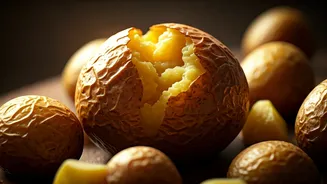
The surprising solution to achieving maximum crispiness in roast potatoes involves a preliminary boiling stage. When potatoes are submerged in boiling water, their starch granules absorb moisture and swell significantly, a process known as gelatinization. This hydration causes the starch to pack together, forming a more uniform and cohesive internal network throughout the potato. This organized starch structure is the critical foundation that dry heat later exploits. Once boiled and tender, the potatoes are ready for the roasting phase. The dry heat then efficiently draws moisture out from this pre-organized, gelatinized surface, leaving behind a rigid, porous starch shell. It's this structure that subsequently dehydrates into the delightful, audible crackle when bitten into, transforming the humble potato into a textural marvel.
The Baking Soda Boost
Further enhancing crispiness can be achieved by introducing a small amount of baking soda to the boiling water. Baking soda increases the alkalinity of the water, which actively accelerates the breakdown of the potato's outer cell walls. As the potatoes boil in this alkaline environment, their surfaces soften and begin to dissolve. When these potatoes are subsequently drained and vigorously tossed, their weakened exteriors fracture and partially collapse. This action creates not only jagged edges but also a starchy slurry that coats each piece. This loose starch acts as a binder. When subjected to high heat during roasting, this starchy coating dries and sets into an exceptionally brittle shell. The combined effect of fractured edges and this gelatinized starch layer dramatically increases the potato's surface area, promoting more efficient moisture evaporation, deeper browning reactions, and ultimately, a significantly crunchier and more satisfying bite.
Testing the Methods
To scientifically validate these concepts, controlled tests were conducted using Yukon Gold potatoes, maintaining consistent quantities, seasoning (1/2 tablespoon oil, 1/8 teaspoon salt), and cooking temperature (400°F or 204°C). The browning phase was performed in an air fryer to ensure uniform hot air circulation and minimize variables. Three methods were compared: raw potatoes directly into the air fryer resulted in uneven browning and soft exteriors; potatoes boiled until fully cooked then air-fried showed noticeably better, even browning and improved crispiness due to starch gelatinization; and finally, potatoes boiled with baking soda, aggressively roughed up, then air-fried, produced the crispiest exterior, deep browning, and fluffy interiors, demonstrating the synergistic effect of alkalinity and surface manipulation.
Maintaining the Crunch
It's important to understand that the crispiness achieved in roast potatoes is inherently temporary. The moment they begin to cool, moisture from the fluffy interior naturally migrates outwards, gradually softening the once-rigid crust. To preserve that delightful crunch for as long as possible, immediate serving is ideal. Alternatively, holding them in a warm oven with good airflow can help. For reheating, a brief stint in an air fryer can revive their crispness. While increasing the amount of oil used might create a slightly more resilient surface, it cannot completely counteract the internal steam migration. Therefore, timing and serving strategy are just as critical as the preparation method for enjoying maximally crispy roast potatoes.