
The Pink Moon's Glow
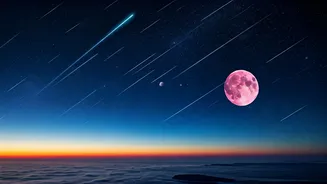
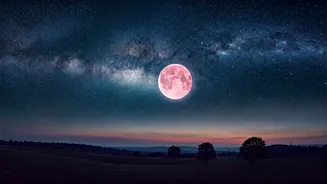
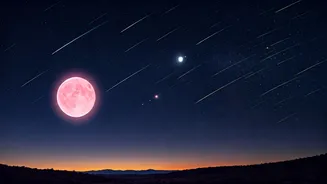
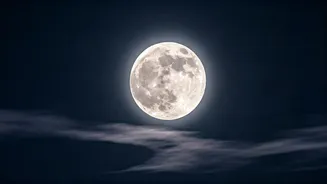
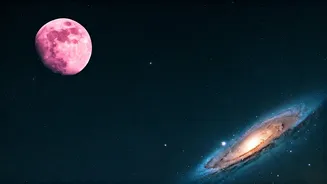
As spring officially graces the Northern Hemisphere, the first full moon of April 2026, known as the Pink Moon, will illuminate the night on April 1st
at 10:12 PM ET. This celestial event earns its name not from its hue, but from its timely appearance alongside the blooming moss pink wildflowers across North America. Furthermore, this particular full moon is poised to be a supermoon, as it will be positioned near its closest orbital point to Earth. This proximity will result in the moon appearing approximately 15% brighter and slightly larger than its average appearance, amplifying its visual splendor and making it an exceptionally captivating sight for observers.
Mercury's Morning Rise
On April 3rd, Mercury will achieve its greatest western elongation, marking the point where it appears farthest from the Sun when viewed from Earth, specifically in the pre-dawn sky. This favorable alignment will make the elusive planet significantly easier to spot, low on the eastern horizon just before sunrise. Typically, Mercury's proximity to the Sun makes it a challenging object to observe, often lost in the Sun's glare. However, during this period, its position allows astronomers and amateur stargazers alike a better chance to study its surface features and its remarkably thin atmosphere without the overwhelming interference of solar light.
Comet C/2026 A1 (MAPS)
Prepare for the potential spectacle of Comet C/2026 A1 (MAPS) as it embarks on a close journey to the Sun on April 4th, passing a mere 850,000 miles away. This close encounter, known as a 'sun-grazing' trajectory, is expected to trigger a dramatic display as the Sun's intense heat causes the comet's icy nucleus to sublimate, releasing gases and dust. This process will likely form a luminous coma and a prominent tail, creating a breathtaking celestial phenomenon. If the comet remains intact during its solar passage, it has the potential to evolve into a 'Great Comet,' a rare and spectacular object visible to the naked eye in the morning sky.
Pre-Dawn Planet Parade
From April 16th to April 23rd, the pre-dawn sky will host a remarkable planetary alignment, offering a rare opportunity to witness Mercury, Mars, Saturn, and Neptune clustered together. While they will appear remarkably close from our perspective on Earth, it's important to remember that these celestial bodies are separated by vast interplanetary distances. Such planetary gatherings are not only visually stunning but also provide valuable moments for astronomers to conduct observations, refine their understanding of orbital mechanics, and calibrate sensitive astronomical equipment, contributing to our broader knowledge of the solar system.
Moon, Venus, Pleiades
Mark your calendars for April 18th and 19th, when the Moon, the dazzling planet Venus, and the famous Pleiades star cluster will converge in a breathtaking celestial close-up. This conjunction will present a visually stunning scene, as these distinct celestial objects appear to share a small patch of the sky. Such an event is a treat for all skywatchers, offering a beautiful tableau that is both aesthetically pleasing for casual observers and scientifically interesting for astronomers keen on tracking the intricate dance of planets and star clusters across the cosmos.
Lyrid Meteor Shower Peaks
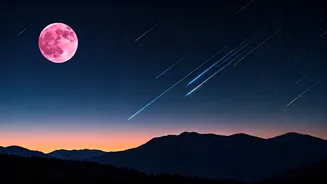
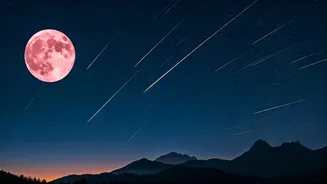
The Lyrid meteor shower will reach its peak activity on April 22nd and 23rd, painting the night sky with streaks of light. This annual display originates from the debris trail left behind by Comet Thatcher, a long-period comet. As Earth traverses this dusty stream of cosmic particles, these tiny fragments enter our atmosphere at incredible speeds of approximately 110,000 miles per hour, burning up and creating the brilliant flashes we perceive as meteors. The Lyrids are one of the oldest documented meteor showers, with a history of observation stretching back over 2,700 years.
Whirlpool Galaxy Views
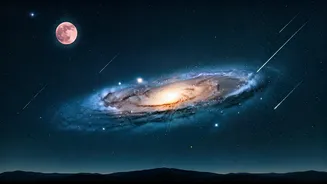
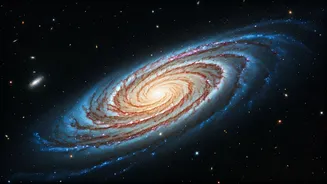
Throughout April 2026, the Whirlpool Galaxy, formally known as Messier 51, will be optimally positioned for observation. Located roughly 31 million light-years from Earth, this magnificent spiral galaxy is currently engaged in a gravitational dance with a smaller companion galaxy, NGC 5195. This interaction makes the Whirlpool Galaxy an exceptional target for astronomers, providing a prime opportunity to study the intricate processes of star formation occurring within its prominent spiral arms and to understand the dynamics of galactic mergers.
End of Aurora Season
As April draws to a close, the Northern Hemisphere will witness the gradual fading of the aurora borealis, commonly known as the Northern Lights. This decline in visibility is primarily due to the increasing daylight hours as the seasons transition. Despite ongoing solar activity that generates the auroras, the brighter skies of late spring and summer make these ethereal displays increasingly difficult to perceive. This period marks the end of the traditional aurora viewing season in the Arctic regions, signaling a shift in celestial viewing priorities for those in higher latitudes.