





Re-establishing Contact
The Artemis 2 mission recently navigated a critical phase, successfully restoring vital communication links with Mission Control after a period of 40 minutes
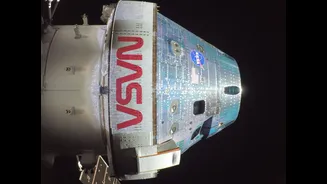
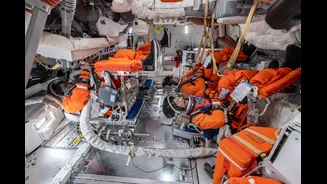
where signals were lost. This occurred as the Orion spacecraft journeyed behind the far side of the Moon, an event that predictably interrupts radio transmissions due to the lunar body acting as a physical barrier. Such an extended 'loss of signal' (LOS) served as a robust examination of both the astronauts' self-reliance and the resilience of the spacecraft's automated systems. Fortunately, at 7:24 PM Eastern Daylight Time on April 6, 2026, contact was re-established, and the crew reported that all onboard systems were functioning optimally. This mission represents the longest distance humans have ventured into deep space to date and is a pivotal step in paving the way for future lunar missions and eventual returns.
Lunar Flyby and Eclipse
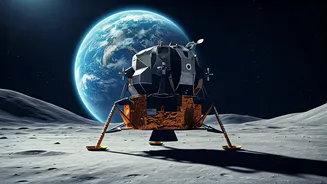
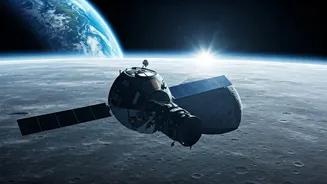
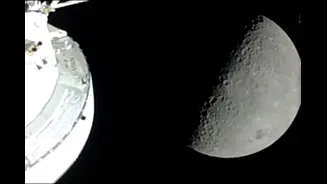
On April 6th, 2026, at 6:44 PM EDT, NASA's Orion spacecraft embarked on a remarkable lunar flyby. As it traversed behind the Moon, it temporarily entered a communication blackout by passing beyond the line of sight of NASA's Deep Space Network. This period of silence was followed by a close flyby of the Moon at 7:02 PM EDT, where Orion came within 4,067 miles of the lunar surface. After communication was restored, the mission entered a unique solar eclipse phase at 8:35 PM EDT. From the perspective of the Artemis 2 crew within Orion, the Moon completely obscured the Sun for 53 minutes, offering an unparalleled opportunity to study the Sun's outer atmosphere, the corona, without the disruptive glare of direct sunlight.
Deep Space Record Shattered
A significant historical achievement was marked for human space exploration on April 6, 2026, at 7:07 PM EDT, as the Artemis 2 crew officially surpassed the previous record for the greatest distance traveled from Earth. The Orion spacecraft reached its furthest point from our planet at an astounding 252,756 miles. This distance is 4,111 miles greater than the record set by the Apollo 13 mission in April 1970, which had stood at 248,655 miles. The crew accomplished this incredible milestone while actively engaged in detailed high-altitude lunar observations, utilizing advanced high-resolution imagery to collect valuable data on the Moon's mineral composition and geological formations.
Journey Home Preparations
As Orion gracefully ascended from behind the Moon at 7:25 PM EDT, the Artemis 2 astronauts were treated to a breathtaking 'Earthrise,' a moment mirrored by Mission Control regaining the crucial signal from the spacecraft. This observation period, spanning over seven hours, allowed the crew to meticulously visually confirm and document various lunar features, including the expansive Orientale Basin and the deep Hertzsprung Basin. The spacecraft is now following a carefully calculated free-return trajectory, leveraging the gravitational pull of both the Earth and the Moon to guide it back towards a planned splashdown in the Pacific Ocean on April 10. This return path is a testament to precise orbital mechanics and mission planning.
Safe Retrieval Operation
NASA and the United States Navy are now fully engaged in the mission recovery phase, orchestrating the safe return of the Artemis 2 crew. The USS John P. Murtha, an amphibious transport dock ship based out of San Diego, has set sail for the designated recovery zone. This vessel is equipped with specialized gear essential for retrieving the Orion capsule from the open ocean, including a purpose-built recovery cradle, swift high-speed boats, and other critical recovery apparatus. NASA's Exploration Ground Systems team is onboard to manage and coordinate these 'Open Ocean Recovery' operations. The anticipated splashdown is scheduled for 8:07 PM EDT (5:07 PM PDT) on April 10, with the landing site located in the Pacific Ocean, approximately 60 miles off the coast of San Diego, California. Upon impact, Navy divers will secure the capsule using a 'horsecollar' flotation device to ensure stability before it is winched into the well deck of the USS John P. Murtha, facilitating the secure return of the astronauts and the spacecraft for subsequent in-depth post-flight analysis.