


Introducing Macrohard
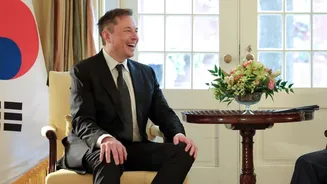
Elon Musk recently announced a significant joint initiative between Tesla and his artificial intelligence company, xAI, a project codenamed 'Macrohard'
or 'Digital Optimus.' The core ambition of this venture is to engineer a sophisticated system capable of replicating the operational functions typically performed by software companies. Musk articulated this vision through a post on his social media platform, X, detailing how the project integrates xAI's advanced Grok large language model, serving as a central 'navigator,' with a specialized AI agent developed by Tesla. This agent is designed to interpret and interact with real-time computer screen visuals, along with simulating keyboard and mouse inputs, effectively allowing the AI to perform tasks on a computer interface as a human would. The timing of this announcement is particularly noteworthy, following the launch of Anthropic's Claude Cowork, which also demonstrated autonomous computer task execution, sending ripples of concern through the software investment community regarding potential business model disruptions by agentic AI. Macrohard's origins trace back to xAI's initial development phase, where it was conceived as a platform for developers to simulate software creations from major tech firms like Microsoft. Musk humorously explained the name 'Macrohard' as a playful nod to Microsoft, highlighting the system's potential to emulate entire corporate functionalities, not just individual software applications.
Technological Backbone
The operational foundation of the Macrohard system relies on a powerful combination of cutting-edge hardware. Musk specified that the AI would be powered by Tesla's proprietary in-house AI4 chip, a testament to the automotive giant's advanced silicon development capabilities. This Tesla-manufactured chip will work in tandem with xAI's server hardware, which is notably based on Nvidia's high-performance components, renowned for their suitability in demanding AI computations. Musk highlighted this integration as a cost-competitive solution, suggesting that the synergy between these hardware elements offers significant value. Further underscoring the project's strategic development, records from the US Patent and Trademark Office indicate that xAI submitted a trademark application for 'Macrohard' back in August 2025, signaling a proactive and long-term approach to its intellectual property. This technological architecture, combining Tesla's specialized AI hardware with robust Nvidia-based infrastructure, is designed to support the complex tasks of emulating software company functions and advanced AI navigation, positioning Macrohard as a significant player in the future of AI-driven software interaction.
Strategic Investments and Future Vision
This ambitious 'Macrohard' project emerges in the wake of significant strategic investments solidifying the relationship between Tesla and xAI. Notably, Tesla committed approximately $2 billion in January to acquire a stake in xAI, demonstrating a deep belief in the startup's potential and a commitment to its technological advancements. Adding another layer to this corporate tapestry, SpaceX recently acquired xAI in an all-stock transaction. This deal valued SpaceX at an impressive $1 trillion and xAI at $250 billion, a valuation that precedes a highly anticipated initial public offering (IPO) for SpaceX later this year. Elon Musk cited the development of orbital data centers as a primary strategic driver behind this merger, suggesting a vision for decentralized, space-based computing infrastructure. The convergence of Tesla's hardware, xAI's AI models, and SpaceX's future space ambitions paints a picture of a vast, interconnected technological ecosystem aimed at pushing the boundaries of what AI can achieve and how it integrates with both terrestrial and extraterrestrial computing capabilities.