





Seeds and Sound
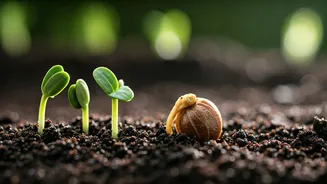
It might sound like science fiction, but recent research from MIT suggests that plants, specifically seeds, can indeed perceive the sound of rain. Unlike
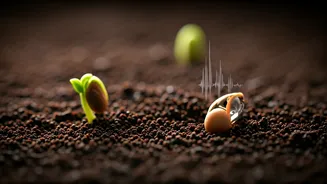
our own auditory experience, this perception is not about recognizing melodies but about sensing vibrations. A study published in Scientific Reports highlights how the gentle patter of raindrops against the soil can act as a significant signal for dormant seeds. This acoustic stimulus has been observed to rouse seeds from their inactive state, prompting them to initiate the germination process at an accelerated pace. This groundbreaking finding provides the first direct evidence that plant life possesses the capacity to detect natural sounds in their environment, a capability that could be crucial for their survival and propagation.
Rain's Vibrational Call
The phenomenon observed by MIT engineers suggests that the energetic vibrations generated by falling raindrops are sufficient to trigger germination in seeds. Professor Nicholas Makris of MIT, a lead author of the study, explains that this acoustic energy can effectively speed up a seed's journey towards growth. Makris and his co-author, Cadine Navarro, hypothesize that the rhythmic sound of rain might be analogous to vibrations produced by other natural forces, such as wind. Their ongoing research aims to explore how plants might perceive a broader spectrum of natural sounds and vibrations. This implies that plants are not passive organisms but are dynamically interacting with their environment through senses we are only beginning to understand, leveraging acoustic cues for critical life cycle events.
Perceptive Plant Life
Plants exhibit an astonishing range of sensory capabilities, honed over millennia for survival. They respond to touch, like the sensitive Mimosa pudica, curl away from noxious odors, and orient themselves towards light sources. The ability to sense gravity is also well-documented. The curiosity that led to this rain-sensing discovery was sparked by questions from Cadine Navarro about the relationship between seeds and sound. Specifically, they wondered if sound vibrations alone could activate the statoliths within seeds, initiating growth. This inquiry prompted a review of older research from the 1980s that measured the intensity of rain sounds underwater. It was noted that water, being denser than air, transmits sound vibrations far more powerfully. The sound pressure experienced by a seed near a raindrop's impact in water could be equivalent to the immense noise levels near a jet engine in the air, underscoring the potential impact of rain sounds.
Rice Seed Experiments
To test their hypothesis, the researchers conducted extensive experiments using approximately 8,000 rice seeds submerged in shallow water. They meticulously simulated different rain intensities—light, moderate, and heavy—by varying droplet sizes and the heights from which they fell. Using hydrophones, they precisely measured the acoustic vibrations produced. The results were compelling: rice seeds exposed to the sounds of falling water germinated 30% to 40% faster compared to control groups that were not subjected to these sounds. Furthermore, seeds located closer to the water's surface demonstrated a greater ability to sense the droplet sounds and exhibited faster growth than those submerged deeper or positioned further away. This suggests a proximity-based sensitivity to acoustic stimuli from rain.
New Meanings
The study's findings offer a profound new interpretation of how plants interact with their environment. Professor Makris suggests that the same cellular mechanisms plants use to sense gravity might also enable them to perceive their depth in soil or water through sound. Sensing the sound of rain allows them to gauge submergence levels, which is vital for survival. This research adds a fascinating dimension to our understanding of plant biology, giving new significance to concepts like the Japanese microseason 'Falling rain awakens the soil.' It implies that the gentle sounds of nature are not merely background noise but carry crucial information that plants actively utilize for their growth and well-being, highlighting an intricate and often hidden world of plant sensory perception.