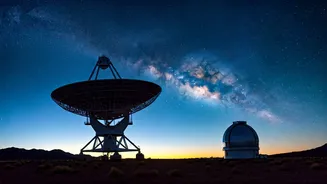









Telescope Types: A Comparison
The field of astronomy utilizes two primary types of telescopes: radio and optical. Optical telescopes, resembling giant eyes, collect visible light, enabling
us to observe stars, planets, and galaxies as we see them. Radio telescopes, on the other hand, are designed to detect radio waves, a different part of the electromagnetic spectrum. Radio waves are essentially longer than the light waves visible to the human eye. This means they can be observed through cosmic dust, unlike optical telescopes, providing unique insights into the universe. Consequently, radio telescopes reveal aspects of the cosmos hidden from traditional optical observation.
Why Space Telescopes?
Infrared telescopes are often placed in space for a very specific reason: to escape the interference of Earth's atmosphere. The atmosphere absorbs and distorts infrared radiation, severely limiting the ability of ground-based telescopes to observe these wavelengths. By placing telescopes in space, scientists can obtain clearer, more detailed images of celestial objects. This positioning also protects them from light pollution and weather conditions, further enhancing observational quality. The placement of telescopes in space helps to ensure that the data being collected is as pure and free from interference as possible, leading to more accurate readings.
Ideal Observatory Locations
Large ground-based telescopes are predominantly built on high mountains in arid areas. There are several factors that contribute to this location strategy. Firstly, the high altitude reduces the amount of atmosphere the light must pass through, minimizing distortion and improving image clarity. Secondly, dry environments are crucial as water vapor absorbs infrared radiation, which is an important aspect of many astronomical observations. Finally, these remote locations are often chosen to avoid light pollution from cities, allowing astronomers to see faint celestial objects more easily. These strategic locations are carefully considered to maximize observation quality and minimize interference from Earth-based phenomena.
Key Telescope Locations
Several locations around the globe have been chosen to house cutting-edge telescopes. The Atacama Large Millimeter/submillimeter Array (ALMA) is located in Chile. This area's high altitude and arid environment make it ideal for observing in the millimeter and submillimeter wavelengths. Another prominent observatory, the Very Large Telescope (VLT), is also based in Chile. Furthermore, Mauna Kea in Hawaii is home to an important observatory due to its high altitude and clear skies. These locations offer optimal conditions for astronomical observations, supporting the advancement of astronomical knowledge. The choice of these locations demonstrates the importance of both geographical and environmental considerations in astronomical research.
Famous Observatories, Missions
The Hubble Space Telescope, launched in 1990, revolutionized astronomy, providing stunning images and groundbreaking discoveries. The ESA's Euclid Observatory has a mission goal to investigate the mysterious nature of dark matter and dark energy, aiming to map the geometry of the universe. The Very Large Telescope (VLT) in Chile is a collection of four individual telescopes that can work together, effectively creating a single, enormous telescope. The Gemini North telescope, located on Mauna Kea, Hawaii, is another critical instrument for astronomical study. The historic Arecibo radio telescope, sadly, collapsed in 2020 after decades of invaluable service, representing a significant loss for the astronomical community, although it served science for several decades.