






What is a Lunar Eclipse?
A lunar eclipse is a captivating celestial display that occurs when our planet, Earth, aligns perfectly between the Sun and the Moon. This cosmic arrangement
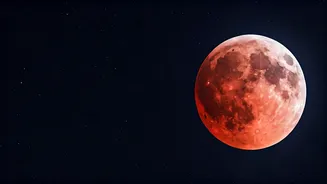
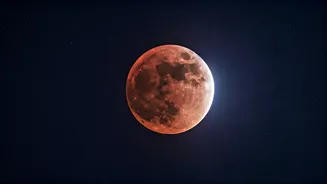
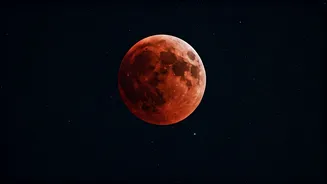
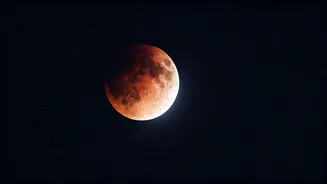
causes Earth to cast a shadow upon the lunar surface, obscuring its usual glow. This precise alignment can only happen during the full moon phase. As sunlight is blocked, the Moon doesn't disappear entirely but often takes on a striking reddish or coppery hue, a sight famously known as the 'Blood Moon.' Unlike their solar counterparts, lunar eclipses are entirely safe to observe with the naked eye and can be enjoyed from any location on Earth experiencing nighttime. These events are not fleeting; they unfold over several hours, with the period of complete shadow, known as totality, sometimes extending up to two hours, providing ample time for observation.
India's Eclipse View
Mark your calendars for March 3rd, 2026, as India is perfectly positioned to witness a breathtaking total lunar eclipse. This event will offer a magnificent spectacle visible across the nation. Unlike the highly localized visibility of solar eclipses, a lunar eclipse is a more inclusive phenomenon. As the Earth positions itself directly between the Sun and the Moon, its expansive shadow envelops our natural satellite. This means that anyone on the night side of Earth, including viewers in India, will have an opportunity to marvel at this celestial event. According to astronomical data from DrikPanchang, in cities like New Delhi and Noida, the Moon will begin its partial eclipse as it rises at approximately 6:26 pm IST, with the entirety of the eclipse concluding around 6:46 pm IST. This upcoming eclipse marks the first total lunar eclipse of 2026 and is a rare occurrence, with the next comparable event not expected until 2029.
The Crimson Hue
The mesmerizing transformation of the Moon into a deep 'Blood Moon' during the totality phase of an eclipse is a result of a fascinating atmospheric phenomenon known as Rayleigh scattering. As the Earth moves directly between the Sun and the Moon, our planet's atmosphere acts as a natural filter for sunlight. While the atmosphere effectively blocks most of the direct sunlight, it bends and scatters the longer wavelengths of light, predominantly the red and orange hues. These reddish wavelengths are then refracted towards the Moon, illuminating its shadowed surface with a warm, crimson glow. This effect is quite similar to why sunsets and sunrises appear red. NASA indicates that this distinct totality phase, where the Moon appears vividly red, typically lasts for about 59 minutes, offering a significant period to appreciate this unique visual spectacle.
Shadow Play Explained
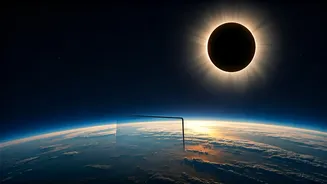
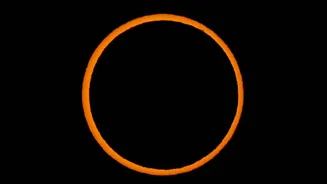
The difference between solar and lunar eclipses lies fundamentally in the arrangement of celestial bodies and the resultant shadows cast. In a solar eclipse, the Moon positions itself between the Earth and the Sun. The Moon's shadow, being relatively small, falls on a narrow path across the Earth's surface, meaning the eclipse is only visible from very specific geographical locations within that shadow zone. Conversely, a lunar eclipse involves the Earth situated between the Sun and the Moon. The Earth's shadow is considerably larger than the Moon's, and it engulfs the Moon. This means that the phenomenon is observable from a much wider area – essentially, anywhere on Earth where the Moon is visible in the night sky. Therefore, lunar eclipses offer a grander, more broadly accessible spectacle compared to the localized experience of a solar eclipse.