




Celestial Pairing Revealed
On the evening of February 23, 2026, the night sky offers a truly captivating sight: the moon will be in close proximity to the renowned Pleiades star
cluster, also known as the Seven Sisters. This particular alignment is expected to be visible high above the southwestern horizon, with the moon appearing just hours before reaching its first quarter phase. The Pleiades, a stunning open star cluster situated in the constellation Taurus, will present a distinct visual treat. Observers will notice the cluster positioned less than five degrees to the upper right of the half-illuminated moon. This relatively close spacing means that the moon and the brightest stars of the Pleiades can even be observed together within the field of view of standard 10x50 binoculars, making it an accessible spectacle for many skywatchers.
The Seven Sisters Unveiled
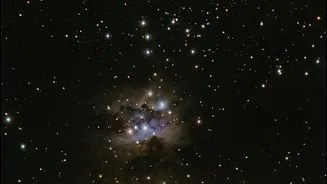
The Pleiades, an ancient star cluster, is celebrated not just for its beauty but also for its rich mythological connections. Its seven most luminous stars bear the names of Asterope, Alcyone, Electra, Celaeno, Merope, Maia, and Taygete, figures from Greek mythology who were the daughters of the titan Atlas. Visually, these prominent stars can resemble the familiar Big Dipper asterism found in Ursa Major, but the Pleiades offers a more intricate celestial tapestry. Through optical aid like binoculars, observers can discern these primary stars surrounded by a multitude of fainter stellar companions, creating a far more complex and dazzling star field. Furthermore, the cluster is enveloped by the ethereal glow of a nearby reflection nebula, adding another layer of cosmic wonder to this already impressive celestial grouping.
Lunar Landscapes Explored
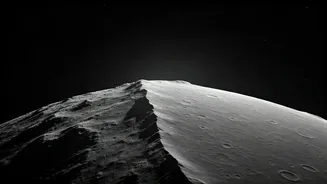
Beyond the allure of the Pleiades, the moon itself presents a compelling astronomical target on this evening. With its disk appearing half-lit, the lunar surface will be dramatically illuminated along the terminator, the line dividing day and night. This provides an excellent opportunity to observe prominent impact craters, many exhibiting intricate details such as overlapping rims and towering central peaks, testaments to colossal cosmic collisions. The dark, basaltic plains of Mare Serenitatis, or the Sea of Serenity, will lie close to this terminator. This region is a remnant of ancient volcanic activity, where molten lava once flowed to fill vast impact basins, smoothing over the lunar terrain. Also visible will be Mare Tranquillitatis, the Sea of Tranquility, a site etched in history as the landing place for humanity's first steps on the moon during the Apollo 11 mission. A telescope would further enhance the viewing experience, revealing the Pleiades' full stellar population and allowing for detailed exploration of the moon's fascinating geological features.