







Assembling the Roman
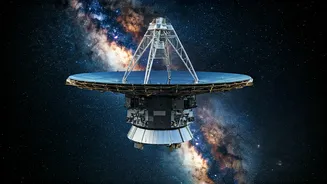
The Nancy Grace Roman Space Telescope, NASA's next-generation orbital observatory, is the successor to the Hubble Space Telescope and the James Webb Space Telescope (JWST).
Construction of Roman has been underway for years at NASA's Goddard Space Flight Center, with the agency recently unveiling the completed telescope. The mission has remained within its initial budget of $4.3 billion. The telescope is roughly 42 feet (12.7 meters) tall and weighs a substantial 9,184 pounds (4,166 kilograms). The assembly of Roman marked a significant milestone for NASA, with the project poised to launch into space later in the year. The telescope's primary objective is to study dark energy and dark matter, along with the discovery of exoplanets and mapping the Milky Way. This mission is a crucial step towards understanding the universe's origins and evolution, offering scientists the tools to probe into the depths of space and analyze its various components. The Roman telescope is expected to begin collecting data around December 27, assuming a launch date of September 28. Experts have hinted that this launch may happen ahead of schedule.
Placement and Launch
Once the Roman telescope is launched, it will be positioned approximately 1 million miles (1.6 million kilometers) from Earth at the Sun-Earth L2 Lagrange point. This point is a stable location in space where the gravitational forces of the sun and Earth balance, allowing the telescope to maintain a fixed position relative to our planet. The launch is planned to happen aboard one of SpaceX's Falcon Heavy rockets from NASA's Kennedy Space Center in Florida. The launch date is currently scheduled for September 28, but could be earlier. A critical step in the process involves transporting the telescope more than 900 miles (1,450 km) from Goddard to the launch site. The telescope is anticipated to begin collecting data around December 27, following a 90-day period required for mission scientists to carry out the necessary steps after launch. The launch date will give us a better indication of how likely a September launch date really is.
Instruments and Goals
Roman is equipped with two primary instruments that will guide its mission. These are the Wide Field Instrument (WFI) and the Coronagraph Instrument. The WFI is a 288-megapixel camera that will capture high-definition images of the outer solar system, the edges of the visible universe, and everything in between, even objects too faint for the human eye to see. The Coronagraph Instrument will block out the light from distant stars, allowing the WFI to photograph exoplanets. The primary goal of Roman is to create the most detailed map of the Milky Way's center, accounting for at least 25% of its total observing time. The telescope will also search for distant galaxy clusters and giant 'cosmic voids' to help uncover the nature of dark matter and dark energy. The telescope is designed to unveil more than 100,000 distant worlds, hundreds of millions of stars, and billions of galaxies within its initial five-year mission.
Data and Discovery
Roman is designed to collect an enormous amount of data, estimated at more than 20,000 terabytes during its initial five-year mission. This data volume is comparable to the storage capacity of approximately 3,000 iPhones. This wealth of information is expected to revolutionize our understanding of the universe. The telescope is anticipated to find more than 15 times as many exoplanets in just five years, which will be a significant boost to scientists exploring the possibility of life beyond Earth. With the capabilities of the telescope, it will provide unprecedented insights into the structure and evolution of the universe. The telescope will observe objects invisible to the naked eye. Through its work, Roman will contribute to answering fundamental questions about the cosmos.
Powering the Mission
The Roman Space Telescope will be powered by six massive solar panels, which will harness the energy of the sun. These solar panels will provide the necessary power for the telescope's instruments and operations throughout its mission. The ability to collect and convert solar energy ensures the longevity and functionality of the telescope. The solar panels will allow the telescope to continue its groundbreaking work. The continuous power supply from the solar panels will be critical for the telescope's ability to observe distant galaxies, map the Milky Way, and search for exoplanets.